

After Bronchiolitis: Can Cleaner Air Protect a Baby’s Developing Lungs?
The recovery from a respiratory infection may depend not only on the virus that caused it but also on the environment in which injured airways are allowed to heal.
The Injured Airway and the Environment
The respiratory tract represents one of the body's most extensive and delicate interfaces with the external environment. Unlike most internal organs, the lungs are continuously exposed to the outside world through the simple act of breathing.
During a severe viral infection, the protective epithelial lining of the airways may be damaged. Inflammation, mucus accumulation and swelling can interfere with airflow, particularly within the narrow airways of infants. Although the infection itself may resolve, the restoration of normal airway function may require considerably more time.
During this period of vulnerability, the developing lungs continue to encounter microscopic particles, combustion products and airborne chemicals generated both inside and outside the home. These environmental exposures may impose an additional inflammatory burden on tissues already recovering from viral injury.
This raises the possibility of a biological interaction between infectious injury and environmental exposure. An initial viral infection may compromise the airway's protective barrier, while subsequent pollutant exposure may interfere with its recovery or contribute to persistent inflammation.
Evidence supporting this possibility has emerged from observational research. A 2021 study involving 921 infants previously hospitalized for bronchiolitis found that children living within 100 meters of major roads had an approximately 59% higher relative hazard of recurrent wheezing than those living more than 300 meters away. Associations with childhood asthma were also identified. Although these findings do not establish causation, they suggest that the environment encountered after a respiratory infection may influence subsequent respiratory health.
An Experiment in the Air Children Breathe
Rather than introducing another medication, a different approach was investigated in the BREATHE Study: reducing the environmental burden placed on recovering airways.
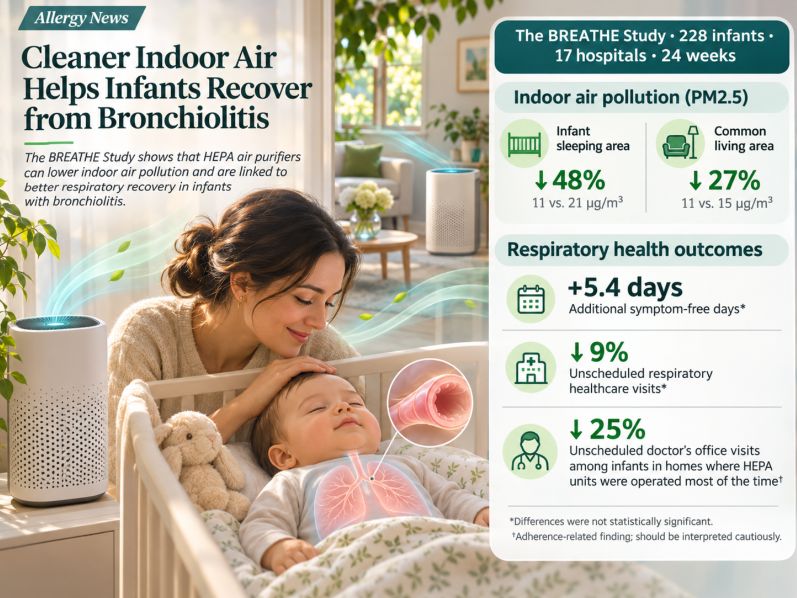
Across 17 American hospitals, 228 infants younger than one year were enrolled following their first hospitalization for bronchiolitis. Families were randomly assigned to receive either functioning HEPA and activated carbon filtration units or identical-looking devices without functional filters.
Air quality was monitored in the infants' homes, and respiratory symptoms were recorded over six months. By using inactive air cleaners as controls, the potential influence of parental expectations on reported symptoms was minimized.
The environmental results were substantial. Compared with control households, fine particulate pollution was approximately 48% lower in infants' sleeping areas and 27% lower in common living spaces where active filtration was used.
The clinical findings, however, were more modest. Infants exposed to filtered air experienced approximately 5.4 additional days without respiratory symptoms during the six-month observation period. Although this difference favored filtration, statistical significance was not reached. A reduction in unscheduled doctor's office visits was also reported among households where filtration units were operated consistently, but this finding requires further confirmation.
The distinction is important. While the ability of HEPA filtration to reduce indoor particulate pollution was demonstrated, a corresponding clinical benefit for infants recovering from bronchiolitis has not yet been conclusively established.
Lung Development Is a Limited Window of Opportunity
Perhaps the most important question raised by the BREATHE Study concerns not the number of symptom-free days gained during six months of recovery, but what might happen over the following six years, or even six decades.
Unlike adult lungs, which have largely completed their development, infant lungs are undergoing rapid structural growth. The airways are expanding, the gas-exchanging structures are developing, and the immune system is learning how to respond to environmental exposures.
Persistent inflammation during this developmental period could potentially have consequences that extend beyond temporary respiratory symptoms. Repeated injury and incomplete tissue repair may contribute to structural changes in the airways, a process known as airway remodeling. If normal lung development is compromised, the respiratory reserve available later in life could also be affected.
In this context, reducing exposure to airborne pollutants may be considered not simply a strategy for controlling symptoms, but a potential approach to protecting lung development itself.
Rethinking Recovery From Respiratory Illness
Modern medicine is often organized around the treatment of disease once it becomes clinically apparent. A respiratory infection is diagnosed, its complications are managed, and recovery is declared when the immediate symptoms have sufficiently improved.
Yet the biological recovery of an injured organ may not follow the same timetable.
For an infant recovering from bronchiolitis, the quality of the surrounding air may deserve consideration alongside nutrition, sleep and other supportive measures. Reducing unnecessary exposure to tobacco smoke, cooking emissions, incense, scented candles and other airborne pollutants may help create a more favorable environment for airway recovery. Mechanical air filtration can complement these measures, although it cannot replace pollution source control or appropriate ventilation.
The BREATHE Study has not established that an air purifier can prevent childhood asthma. Nevertheless, it raises an important question about the relationship between environmental exposure, airway inflammation and early lung development.
Perhaps protecting the future health of a child's lungs begins not only with treating respiratory disease, but also with protecting the environment in which those lungs are expected to heal and grow.
Reference
1. Cowan K, Semmens EO, Lee JY, et al. Bronchiolitis recovery and the use of High Efficiency Particulate Air (HEPA) Filters (The BREATHE Study): study protocol for a multi-center, parallel, double-blind, randomized controlled clinical trial. Trials. 2024;25(1):197. doi:10.1186/s13063-024-08012-0
2. Cowan K, Semmens EO, Walker ES, et al. The BREATHE Study: a randomized controlled trial of bronchiolitis recovery and use of HEPA filters. Am J Respir Crit Care Med. 2025;211(suppl 1):A7226. doi:10.1164/ajrccm.2025.211.abstracts.A7226
3. The BREATHE Study Team. The BREATHE Study: bronchiolitis recovery and use of HEPA filters. Environmental Influences on Child Health Outcomes. October 27, 2025. Accessed November 24, 2026. ECHO research summary
4. Freid RD, Qi Y, Espinola JA, et al. Proximity to major roads and risks of childhood recurrent wheeze and asthma in a severe bronchiolitis cohort. Int J Environ Res Public Health. 2021;18(8):4197. doi:10.3390/ijerph18084197
5. American Academy of Pediatrics. Indoor air pollutants. Updated January 8, 2024. Accessed November 24, 2026. American Academy of Pediatrics