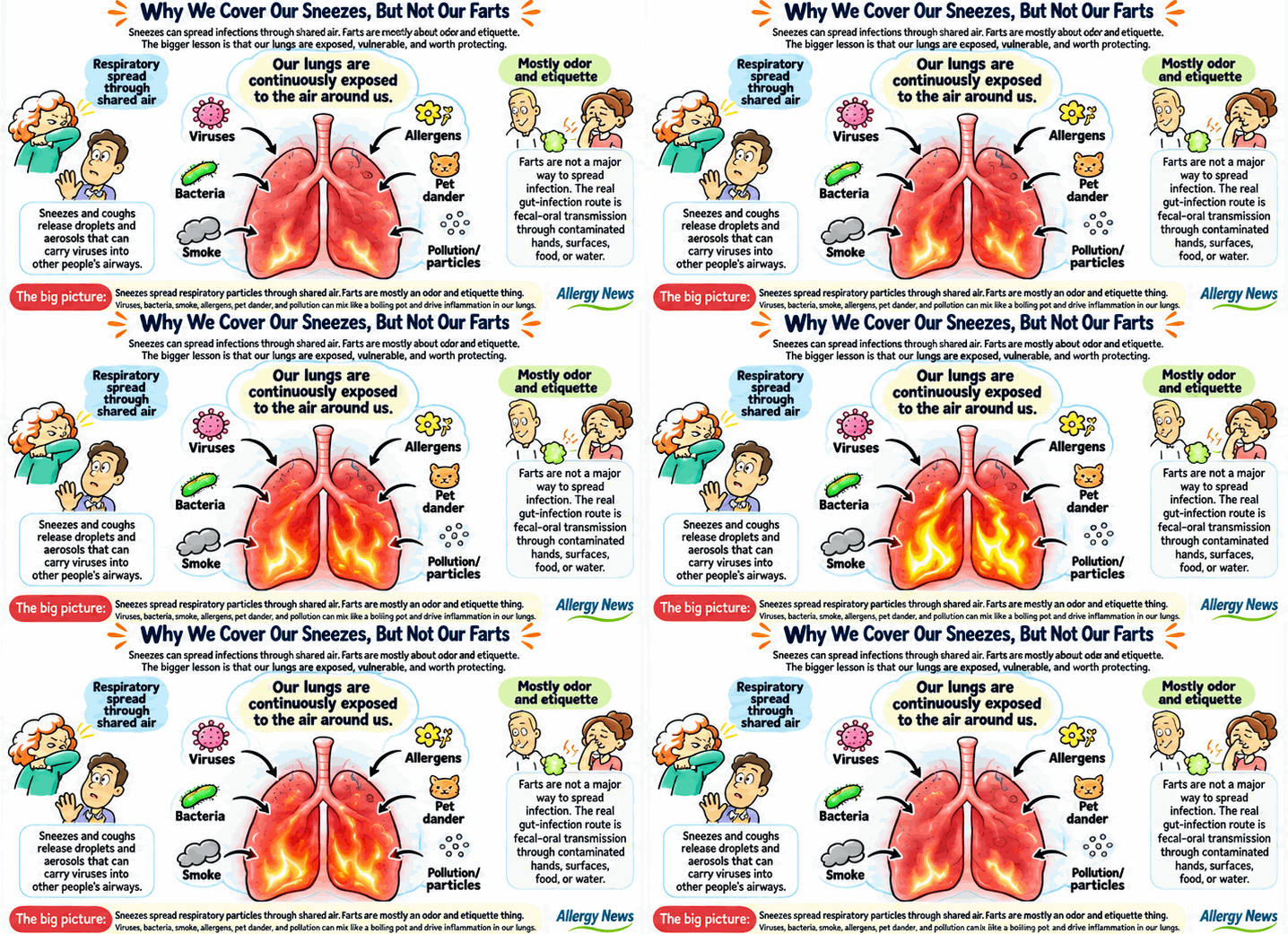
We instinctively protect ourselves from someone else's cough or sneeze, yet rarely worry about the infectious risks of passing gas. This familiar cultural difference reveals something important about how diseases spread, how vulnerable our lungs are to the surrounding environment, and why respiratory health deserves greater attention throughout life.
Why Society Fears a Sneeze but Not a Fart
From childhood, we are taught to cover our mouths and noses when coughing or sneezing. Across many cultures, sneezing openly toward another person is considered inconsiderate, while coughing without covering one's mouth may provoke an immediate reaction. These expectations are grounded in an important biological reality: respiratory infections can spread through particles released into the surrounding air.
Yet passing intestinal gas, commonly known as farting, is treated quite differently. Although it may cause embarrassment or unpleasant odors, it is generally not regarded as a significant infectious threat. People are not instructed to cover themselves whenever they pass gas, and public health campaigns rarely address flatulence as a means of transmitting disease.
The difference reflects more than social convention. It illustrates how the respiratory and digestive systems interact with the environment and how infectious organisms move between people.
But the comparison raises a larger question: If we recognize how easily infectious particles can leave our lungs and reach others, why do we pay comparatively little attention to the health of the delicate tissues inside our lungs that are exposed to these same particles every day?
Why Sneezing Can Spread Infections So Easily
Sneezing is a protective reflex that helps remove irritants and foreign material from the nose and upper respiratory tract. During a sneeze, air is forcefully expelled along with tiny droplets of respiratory fluid. If someone has an infection such as influenza, COVID-19, or the common cold, some of these particles may contain infectious viruses.
Respiratory particles vary considerably in size. Larger droplets may settle onto nearby surfaces or reach another person's eyes, nose, or mouth. Smaller particles can remain suspended in the air, particularly in crowded or poorly ventilated spaces, where they may be inhaled by others.
The World Health Organization recognizes that infectious respiratory particles can be released not only through coughing and sneezing but also through ordinary breathing, speaking, and singing.¹ This makes respiratory transmission particularly difficult to prevent. People sharing the same indoor air may be exposed to infectious particles without touching one another or consuming anything contaminated.
Not every sneeze is infectious, however. Allergies, dust, fragrances, and other irritants can trigger sneezing without an underlying infection. Nevertheless, because the cause is not always apparent to observers, covering the mouth and nose has become a reasonable precaution and an expression of consideration toward others.
Why Farting Is Different From Sneezing
Unlike sneezing, which releases respiratory fluids, farting primarily expels gases from the digestive tract. These gases originate from swallowed air and bacterial activity during digestion. Most are odorless, while the characteristic unpleasant smell comes from small quantities of sulfur-containing compounds and other volatile substances.
Although the intestines contain trillions of microorganisms, the presence of intestinal bacteria does not mean that ordinary flatulence is an important route of infection.
An unusual observation published in the BMJ in 2001 explored whether bacteria could be dispersed through flatulence. In a small informal experiment, bacteria were recovered from a culture plate exposed directly to flatulence without clothing. However, bacterial growth was not observed when flatulence passed through trousers. The observation suggested that clothing could act as a physical barrier, although the experiment was too limited to establish how often bacteria are released or whether infection could result.
This distinction is important. The unpleasant smell of a fart does not mean that infectious microorganisms are floating through the air. Odor molecules are chemically different from bacteria and viruses, and detecting a smell is not equivalent to being exposed to an infectious pathogen.
Ordinary flatulence through clothing is therefore not considered a significant source of infectious disease.
Why Fecal–Oral Transmission Can Still Be Dangerous
The digestive system contains many microorganisms that can cause serious infections when transferred from one person to another. However, the principal concern is generally not intestinal gas but contamination involving fecal material, vomit, food, water, or hands.
This process is known as fecal–oral transmission. Infectious organisms shed in feces may contaminate toilets, hands, bathroom surfaces, food preparation areas, or drinking water. When microscopic amounts of this material subsequently enter another person's mouth, infection may occur.
Norovirus provides an important example. According to the Centers for Disease Control and Prevention, this highly contagious virus can spread through contaminated food, water, surfaces, and direct contact with infected individuals. Only a small number of viral particles may be sufficient to cause illness.
Vomiting can also disperse virus-containing droplets into the surrounding environment, contaminating nearby surfaces and food. This illustrates why gastrointestinal infections should not be dismissed simply because their usual transmission routes differ from those of respiratory infections.
In fact, certain intestinal pathogens are extraordinarily efficient at spreading through the fecal–oral route. It would therefore be misleading to conclude that airborne transmission is always more contagious or dangerous than intestinal transmission.
The fundamental difference is how exposure occurs. Respiratory pathogens can enter susceptible tissues when infectious particles are inhaled or deposited on mucous membranes, while fecal–oral pathogens generally cause infection after contaminated material is swallowed.
Why We Fear Invisible Germs but React to Smelly Gas
Human reactions to sneezing and farting are influenced by both biology and culture.
Sneezing and coughing have become associated with illness because they can visibly disperse respiratory secretions. During outbreaks of influenza, COVID-19, and other respiratory diseases, these behaviors naturally attract greater attention. The concern is not necessarily the sneeze itself but the possibility that infectious particles have entered shared air.
Farting, by contrast, is usually associated with unpleasant smells, embarrassment, and violations of social etiquette. The odor is immediately noticeable, but it generally does not indicate infectious danger.
This creates an interesting contrast: a strong-smelling fart may be unpleasant but pose little infectious risk, while a completely odorless cloud of respiratory aerosols may contain pathogens capable of causing disease.
Our senses, therefore, do not always provide reliable information about infection risk. Something that smells unpleasant is not necessarily dangerous, while infectious particles may be entirely invisible and odorless.
Cultural expectations have developed around these differences, although etiquette varies among communities. Covering a sneeze is both a matter of politeness and a recognized infection-prevention practice, whereas avoiding flatulence in public is primarily associated with social comfort and consideration for others.
We Protect Others From Our Sneezes, But Are We Protecting Our Own Lungs?
There is another interesting contradiction in how society approaches respiratory health. Considerable attention is given to preventing infectious particles from leaving our respiratory system, yet much less attention is devoted to routinely measuring how well our lungs are functioning.
Preventive healthcare commonly includes measurements of blood pressure, cholesterol, blood glucose, height, and weight. However, routine lung-function assessment has not become a comparable standard for otherwise healthy children and adults.
This gap deserves further investigation. Research published in The Lancet has demonstrated that lung function follows different trajectories throughout life, with some individuals failing to achieve expected lung growth during childhood and others experiencing accelerated decline during adulthood. Yet these changes may remain unrecognized until respiratory symptoms become more apparent.
Spirometry, a noninvasive breathing test, can help identify airflow abnormalities and assess respiratory function. Traditionally, lung-function assessment has emphasized airflow limitation and the diagnosis of established respiratory diseases such as asthma and chronic obstructive pulmonary disease. Yet airway disease involves more than airflow obstruction. Inflammatory changes may develop before substantial functional impairment becomes evident, and respiratory symptoms do not always reflect the underlying extent of disease.
A stronger preventive approach could begin with greater attention to respiratory symptoms, environmental exposures, and timely lung-function testing when clinically indicated. Earlier recognition and appropriate treatment of respiratory disease may help preserve lung health, although preventing the spread of infections still requires specific infection-control measures.
Protecting others from what comes out of our respiratory tract is important, but understanding and protecting the health of the lungs themselves deserves attention as well.
The Lesson Behind an Everyday Cultural Habit
The question of why we cover our sneezes but not our farts may initially sound humorous, yet it reveals an important distinction between respiratory and gastrointestinal disease transmission.
Sneezing and coughing can release infectious particles directly into shared air, making respiratory hygiene important for protecting people nearby. Ordinary flatulence, despite its unpleasant odor, is not considered an important route of infection. Intestinal pathogens instead spread predominantly through contamination involving fecal material, vomit, hands, food, water, and surfaces.
Neither transmission route is universally more dangerous. Each presents different risks depending on the infectious organism, the environment, and human behavior.
Perhaps the most interesting lesson is that what we can smell is not necessarily what should concern us most. A fart may offend our senses, but an invisible and odorless respiratory particle can sometimes pose a far greater infectious threat.
Society has learned to cover its sneezes to protect others. Perhaps preventive healthcare should also give greater attention to evaluating and protecting the respiratory system that produces those sneezes, rather than waiting until breathing problems become obvious.
Reference
1. World Health Organization. Leading health agencies outline updated terminology for pathogens that transmit through the air. Published April 18, 2024. www.who.int/news/item/18-04-2024-leading-health-agencies-outline-updated-terminology-for-pathogens-that-transmit-through-the-air
2. Chapman S. Hot air? BMJ. 2001;323(7327):1449. www.pmc.ncbi.nlm.nih.gov/articles/PMC1121900/
3. Centers for Disease Control and Prevention. How norovirus spreads. www.cdc.gov/norovirus/causes/
4. Melén E, Faner R, Allinson JP, et al. Lung-function trajectories: relevance and implementation in clinical practice. Lancet. 2024;403(10435):1494-1503. doi:10.1016/S0140-6736(24)00016-3
5. US Preventive Services Task Force. Chronic obstructive pulmonary disease: screening. Published May 10, 2022. www.uspreventiveservicestaskforce.org/uspstf/recommendation/chronic-obstructive-pulmonary-disease-screening