

Can COVID-19 Make Asthma Worse for Months After Recovery?
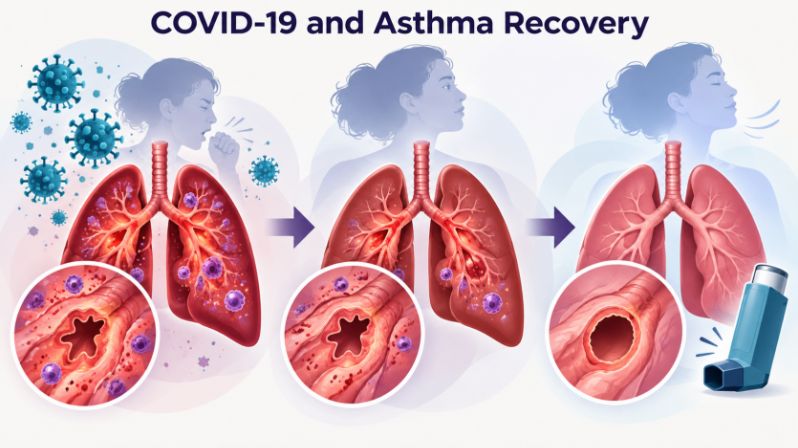
For some people with asthma, recovering from COVID-19 does not mean breathing returns to normal. Research suggests that the infection may leave already sensitive airways more difficult to control, sometimes for months after the initial illness has passed.
When a Mild Infection Leaves a Lasting Respiratory Burden
Researchers at the University of São Paulo in Brazil examined 208 adults with asthma who received care between 2020 and 2021. Most had lived with the disease for decades, and nearly three-quarters required relatively intensive asthma treatment. During the study period, 59 participants developed laboratory-confirmed COVID-19.
For most, the acute infection was not life-threatening. Eleven patients required hospitalization and supplemental oxygen, but none needed intensive care or mechanical ventilation. Yet the course of their asthma told a different story.
Among patients who contracted COVID-19, 33.9 percent experienced worsening asthma control, compared with 11.4 percent of those who had not been infected. The difference was statistically significant, suggesting that COVID-19 may have been associated with a substantially greater likelihood of asthma deterioration.
The researchers did not define worsening asthma simply as a lingering cough. Patients had persistent respiratory symptoms, a meaningful decline in their Asthma Control Test scores, and a need for additional maintenance medication. Among those whose asthma worsened after infection, the increased treatment was required for an average of 6.14 months during the study's follow-up period.
These findings suggest that recovery from COVID-19 and recovery of asthma control may follow different timelines. A patient may no longer have an active viral infection but still experience chest tightness, wheezing, disturbed sleep, or shortness of breath that interferes with daily activities.
Importantly, the study was observational and cannot establish that COVID-19 directly caused every episode of worsening asthma. Nevertheless, the difference between infected and uninfected patients suggests that the possibility deserves clinical attention.
How a Respiratory Virus Can Disturb Sensitive Airways
Asthma is fundamentally a disease of airway inflammation. The lining of the bronchial tubes can become swollen and unusually sensitive, while surrounding muscles tighten and mucus production increases. Respiratory viruses are well-established triggers of these changes because infection can disturb the airway's protective epithelial barrier and activate immune responses.
Why Some Patients Have a More Difficult Recovery
Not everyone with asthma experienced prolonged breathing problems after COVID-19. In the Brazilian study, approximately two-thirds of infected participants did not meet the researchers' criteria for worsening asthma control. Understanding why some recovered more smoothly than others remains an important challenge.
Patients who subsequently experienced asthma deterioration were more likely to have reported shortness of breath and wheezing during the initial infection. These symptoms may provide early clues that the lower airways have been substantially affected and that closer follow-up is warranted.
Interestingly, the extent of lung abnormalities visible on chest CT scans was not significantly associated with later worsening of asthma. This suggests that structural changes detectable through imaging may not fully capture the functional disturbances occurring within the airways.
The researchers also examined whether allergic asthma behaved differently from other inflammatory forms of the disease. Although patients with type 2 asthma generally had earlier disease onset and greater treatment requirements, the study found no statistically significant difference in COVID-19 infection rates between the inflammatory groups.
These findings highlight the complexity of asthma. The disease is not defined solely by how frequently someone wheezes or how much medication is required. Different inflammatory pathways, environmental exposures, underlying medical conditions, and individual immune responses may all contribute to how the respiratory system reacts to infection.
Is Persistent Asthma After COVID-19 a Form of Long COVID?
Persistent asthma symptoms after COVID-19 raise an important diagnostic question. Are patients experiencing a prolonged flare of their existing asthma, a separate post-COVID condition, or a combination of both?
Vaccination and the Importance of Continued Asthma Care
The Brazilian investigators also examined COVID-19 vaccination. By the end of the study, 177 participants had received at least one vaccine dose, and only six reported mild, temporary adverse effects. Five patients developed COVID-19 after vaccination, and none experienced subsequent asthma worsening. Although reassuring, this group was too small to establish a protective effect against prolonged asthma deterioration. Most infections in the study occurred before vaccination, limiting meaningful comparisons between vaccinated and unvaccinated patients.
For patients recovering from COVID-19, the more immediate clinical lesson concerns ongoing asthma management. Coughing, wheezing, nighttime symptoms, increased use of rescue medication, or breathlessness that persists after the infection should prompt reassessment rather than being automatically attributed to long COVID.
The 2026 Global Initiative for Asthma recommendations emphasize regular assessment of symptom control, lung function, inhaler technique, adherence, and factors that may contribute to poor control. Inhaled corticosteroid-containing treatments remain central to asthma management, while treatment adjustments should be individualized and reassessed as symptoms improve.
Recovery Means More Than Clearing the Virus
The Brazilian study was retrospective, involved a relatively small number of patients at a specialized asthma center, and took place during the early pandemic, before later viral variants and widespread vaccination changed the clinical landscape. Its findings cannot necessarily be generalized to all patients with asthma, particularly those with milder disease or different treatment histories.
Nevertheless, the study draws attention to an important distinction between recovery from a viral infection and recovery of normal respiratory function. For some individuals, the period after COVID-19 may involve a temporary loss of asthma control that requires months of additional treatment.
For people with asthma, the weeks and months following COVID-19 may be an important period of respiratory recovery. Some patients return quickly to their usual level of control, while others may require closer monitoring and temporary adjustments in treatment.
The central lesson extends beyond COVID-19. Respiratory infections can interact with chronic inflammatory diseases in ways that continue after the immediate infectious threat has passed. Understanding these lingering effects may help clinicians recognize patients whose recovery is incomplete and intervene before prolonged breathing difficulties become an accepted part of daily life.
For someone with asthma, true recovery is not simply the absence of infection. It is the return of comfortable breathing, restful sleep, and stable control of the disease.
Reference
1. Agondi RC, Menechino N, Marinho AKBB, Kalil J, Giavina-Bianchi P. Worsening of asthma control after COVID-19. Front Med (Lausanne). 2022;9:882665. doi:10.3389/fmed.2022.882665
2. Alhumaid S, Sabr Z, Alshehri SM, et al. Asthma control and exacerbation risk following SARS-CoV-2 infection in the post-acute COVID-19 phase: a systematic review. Allergy Asthma Clin Immunol. 2026;22(1):36. doi:10.1186/s13223-026-01027-z
3. Kimura H, Francisco D, Conway M, et al. Type 2 inflammation modulates ACE2 and TMPRSS2 in airway epithelial cells. J Allergy Clin Immunol. 2020;146(1):80-88.e8. doi:10.1016/j.jaci.2020.05.004
4. Soriano JB, Murthy S, Marshall JC, Relan P, Diaz JV; WHO Clinical Case Definition Working Group on Post-COVID-19 Condition. A clinical case definition of post-COVID-19 condition by a Delphi consensus. Lancet Infect Dis. 2022;22(4):e102-e107. doi:10.1016/S1473-3099(21)00703-9
5. Global Initiative for Asthma. Summary Guide for Asthma Management and Prevention: For Adults, Adolescents and Children 6–11 Years. Updated 2026. Published July 2026. Accessed October 22, 2026. Official GINA 2026 Summary Guide