

Asthma Death Rates Are Falling, but a Troubling Pattern Is Emerging Among Younger Generations
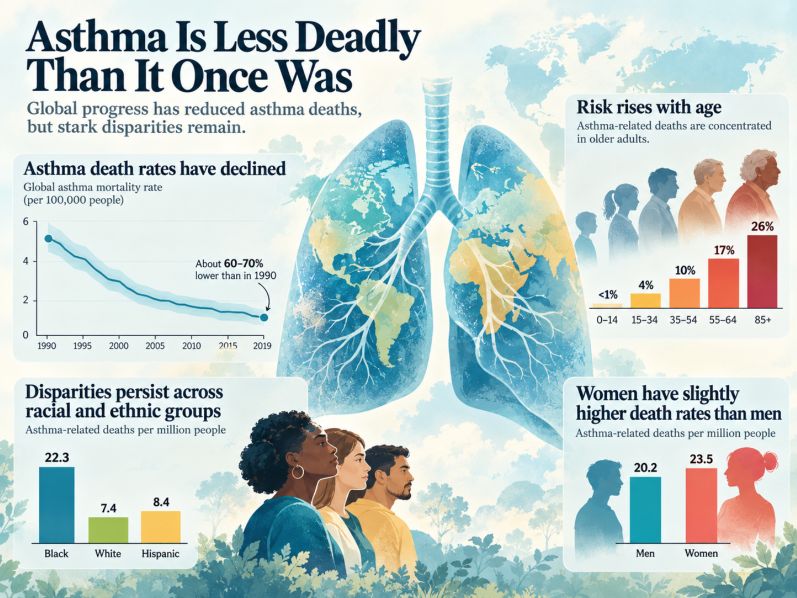
Global asthma mortality rates have declined over three decades, yet the number of deaths remains remarkably unchanged. Meanwhile, a study suggests that more recent generations may face a greater risk of developing the disease, raising questions about environmental change and the limits of medical progress.
The Asthma Paradox: Lower Death Rates, but Nearly as Many Deaths
For millions of people worldwide, asthma remains a persistent and sometimes unpredictable respiratory disease. Episodes of coughing, wheezing, chest tightness, and breathlessness can interrupt sleep, restrict physical activity, and occasionally become life-threatening. Although medications are available to control airway inflammation and relieve symptoms, the disease continues to impose a substantial burden on patients and healthcare systems.
A study published in Frontiers in Public Health examined asthma trends across 204 countries and territories between 1990 and 2019. The researchers identified an apparently encouraging development: the global rates of asthma incidence and mortality had declined. Yet beneath those improvements, several troubling patterns remained.
In 1990, approximately 32.2 million new asthma cases were estimated worldwide. By 2019, that number had increased to nearly 37 million, a rise of about 15%. However, the annual incidence rate declined from 601 to 478 cases per 100,000 people, approximately a 21% reduction.
Mortality showed a similar divergence. The annual asthma death rate declined from 8.60 to 5.96 per 100,000 people, a reduction of approximately 31%. A separate age-standardized analysis estimated an even larger decline of about 51%.²Despite these reductions in mortality rates, the absolute number of asthma deaths remained almost unchanged, at approximately 460,000 annually in both 1990 and 2019.
The distinction matters. A declining mortality rate suggests that the risk of dying from asthma has fallen relative to the population, but it does not necessarily mean that the total burden of fatal asthma has diminished. Population growth, aging, differences in disease recognition, and changes in environmental risk factors can influence these trends.
Improvements in asthma management may have contributed to declining mortality rates, but the study was not designed to measure the effects of specific treatments. Its findings therefore offer evidence of changing population-level outcomes rather than direct proof of therapeutic progress.
Why Might Younger Generations Face a Greater Risk?
One of the more concerning findings emerged when researchers examined asthma patterns according to birth generation.
Using an age-period-cohort statistical model, the investigators attempted to distinguish the influences of aging, historical changes, and circumstances shared by people born during particular periods.
The analysis suggested that the relative risk of developing asthma increased among more recent birth cohorts. The modeled relative risk rose from 0.85 among people born between 1965 and 1969 to 1.37 among those born between 2015 and 2019.
These estimates appear to conflict with the overall decline in asthma incidence. But the findings describe different dimensions of the disease. Population-wide incidence reflects the changing composition of societies, whereas birth-cohort analysis attempts to identify patterns associated with successive generations.
The findings raise an important question: could the environments in which children are born and raised be changing in ways that influence asthma susceptibility?
Asthma develops through complex interactions among genetics, immune development, and environmental exposures. Maternal smoking, premature birth, respiratory infections, and exposure to air pollution have been associated with increased asthma risk. Other influences, including indoor air quality, allergen exposure, and changing patterns of microbial contact, are also being investigated.
Over recent decades, many children have grown up in increasingly urbanized environments, spending more time indoors and encountering different combinations of airborne pollutants, household chemicals, allergens, and infectious agents than previous generations.
Whether these changes explain the observed birth-cohort patterns remains uncertain. The study cannot establish a causal relationship between modern environmental exposures and increasing asthma susceptibility, and estimates for the youngest generations are particularly limited by their short observation periods.
Nevertheless, the findings suggest that changes in asthma risk deserve attention even when overall incidence rates appear to be improving.
Asthma Is Most Common in Early Childhood but Most Dangerous in Old Age
The global analysis also revealed striking differences in how asthma affects people throughout life.
Children younger than five had the highest modeled relative risk of asthma incidence, approximately three times the average risk across age groups. Incidence declined through adolescence and early adulthood, reaching its lowest level among people aged 30 to 34 before increasing again later in life.
Early childhood represents a period of rapid airway and immune development. Respiratory infections, environmental exposures, and inherited susceptibility may influence whether wheezing symptoms eventually develop into persistent asthma. Yet not all childhood wheezing represents chronic asthma, complicating diagnosis and epidemiological estimates.
Mortality followed a different pattern. The risk of asthma-related death increased progressively with age and was highest among adults aged 90 to 94.Older adults often experience reduced respiratory reserve, multiple chronic medical conditions, and greater difficulty distinguishing asthma symptoms from other respiratory or cardiovascular diseases. These factors may complicate diagnosis, treatment, and recovery from severe exacerbations.
Global population aging adds another layer to this problem. Between 1990 and 2019, the proportion of people aged 65 and older increased substantially. This demographic shift may help explain why the absolute number of asthma deaths remained relatively stable despite declining mortality rates.
The findings suggest that asthma cannot be understood solely as a childhood disease. Its clinical consequences extend throughout life, and its greatest mortality burden occurs among older populations.
Why Wealthier Countries Report More Asthma but Poorer Countries Experience More Deaths
The geographic distribution of asthma revealed another apparent contradiction.
Countries with higher socioeconomic development generally reported higher asthma incidence rates. In 2019, the United States and Puerto Rico were among the locations with the highest estimated age-standardized incidence. The United States recorded approximately 1,547 new cases per 100,000 people.
Higher reported incidence may reflect a combination of environmental exposures, true differences in disease occurrence, and more extensive diagnostic and surveillance systems. In countries with better healthcare access, asthma is more likely to be recognized and recorded, whereas cases in resource-limited settings may remain undiagnosed.
The relationship reversed when researchers examined mortality.
Lower-income regions experienced disproportionately high asthma death rates, with Kiribati and Papua New Guinea among the countries reporting the highest estimated mortality in 2019.These disparities suggest that socioeconomic conditions influence not only how asthma is identified but also the consequences of living with the disease.
Access to essential medications, continuity of preventive care, emergency treatment, and trained healthcare professionals varies widely between countries. In some settings, patients may rely on intermittent symptom relief because regular controller medications are unaffordable or unavailable.
However, differences in healthcare access are unlikely to explain every variation in mortality. Environmental exposures, coexisting illnesses, diagnostic uncertainty, and limitations in national death-reporting systems may also influence the observed patterns.
The study therefore highlights substantial global inequalities without establishing how much of the mortality gap can be attributed to any single cause.
Asthma Treatments Have Improved, but Their Impact on Global Mortality Remains Uncertain
Could Environmental Prevention Make a Greater Difference?
The persistence of millions of new asthma cases each year raises a question that treatment alone cannot resolve: what determines whether asthma develops in the first place?
Because asthma arises from interactions between inherited susceptibility and environmental influences, prevention is considerably more complicated than avoiding a single trigger. Population-level strategies have increasingly focused on reducing harmful exposures, improving respiratory health, and addressing modifiable risk factors.
Finland's national Allergy Programme, implemented between 2008 and 2018, offers one example of a coordinated approach. The initiative emphasized appropriate diagnosis and management, environmental health, greater attention to immune tolerance, and public education. During the program, asthma-related hospital utilization and several measures of allergic disease burden declined. These results suggest that broad public health efforts can coincide with improvements in disease outcomes, although they do not establish that the program prevented new asthma cases or that any individual intervention was responsible for the observed changes.
Similarly, reducing tobacco smoke exposure and improving air quality may offer respiratory health benefits, but their effects on asthma development depend on the timing and nature of exposure and the susceptibility of the individual. The challenge is to determine which preventive measures can meaningfully reduce asthma incidence across populations rather than merely improving symptoms in those already affected.
The study's finding of increasing modeled asthma risk among more recent birth cohorts provides a reason to investigate these questions further.
The Unfinished Challenge of Asthma
The global decline in asthma mortality rates represents an encouraging epidemiological trend, but it should not be mistaken for evidence that asthma is approaching control worldwide. Nearly 37 million new asthma cases and approximately 461,000 asthma-related deaths were estimated in 2019. The annual number of deaths had changed remarkably little over the preceding three decades, and substantial differences in outcomes persisted between wealthy and resource-limited countries.
At the same time, the possibility of increasing asthma susceptibility among younger generations suggests that some determinants of the disease may be evolving even as population-wide rates decline.
These findings are based on modeled historical data ending in 2019, and they cannot establish how asthma incidence or mortality has changed in more recent years. Nor can they identify which specific medical, environmental, or social factors produced the observed trends.
Still, the study offers an important reminder that the success of asthma care cannot be judged solely by declining mortality rates. The number of people developing the disease, the persistence of preventable complications, the inequalities in access to treatment, and the potential influence of changing environments all deserve consideration.
Modern asthma therapies can reduce symptoms and the likelihood of severe attacks, but they do not eliminate the disease or fully explain its changing global patterns.
The larger challenge is to understand not only how to prevent deaths from asthma, but also why so many people continue to develop it, and whether future generations can be protected before the disease begins.
Reference
1. Cao Y, Chen S, Chen X, et al. Global trends in the incidence and mortality of asthma from 1990 to 2019: an age-period-cohort analysis using the Global Burden of Disease Study 2019. Front Public Health. 2022;10:1036674. doi:10.3389/fpubh.2022.1036674
2. Safiri S, Carson-Chahhoud K, Karamzad N, et al. Prevalence, deaths, and disability-adjusted life-years due to asthma and its attributable risk factors in 204 countries and territories, 1990-2019. Chest. 2022;161(2):318-329. doi:10.1016/j.chest.2021.09.042
3. Stern J, Pier J, Litonjua AA. Asthma epidemiology and risk factors. Semin Immunopathol. 2020;42(1):5-15. doi:10.1007/s00281-020-00785-1
4. Global Initiative for Asthma. 2026 GINA Summary Guide for Asthma Management and Prevention: For Adults, Adolescents and Children 6–11 Years. Global Initiative for Asthma; 2026. Accessed October 12, 2026. https://ginasthma.org/2026-gina-summary-guide/
5. Haahtela T, Valovirta E, Saarinen K, et al. The Finnish Allergy Program 2008-2018: society-wide proactive program for change of management to mitigate allergy burden. J Allergy Clin Immunol. 2021;148(2):319-326.e4. doi:10.1016/j.jaci.2021.03.037