

Can Asthma Be Stopped Before It Leaves Permanent Scars? How Anti-IgE Therapy May Change the Disease Itself
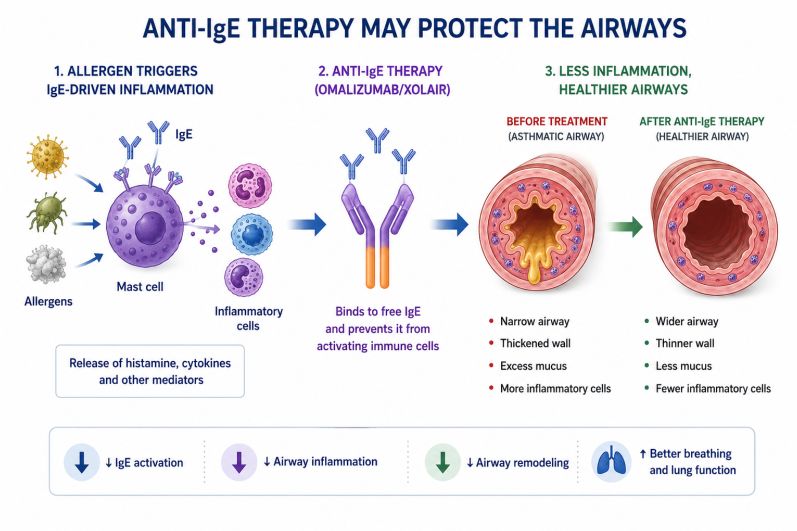
For decades, asthma treatment has focused on controlling symptoms, reducing flare-ups, and preserving lung function. Yet many people with persistent allergic asthma continue to experience a gradual decline in breathing despite feeling relatively well between attacks. One important reason is a process known as airway remodeling, in which chronic inflammation slowly reshapes the structure of the airways.
Asthma Is More Than Intermittent Airway Narrowing
IgE: A Small Antibody With Outsized Influence
At the center of allergic asthma lies an antibody called immunoglobulin E, or IgE. IgE serves as an early warning system for the immune system. After a person becomes sensitized to an allergen such as pollen, dust mites, pet dander, or mold, IgE antibodies bind tightly to mast cells and other immune cells lining the airways. During the next exposure, allergens cross-link these IgE molecules, triggering an almost immediate release of histamine and numerous inflammatory chemicals.
That initial response is only the beginning. Within hours, eosinophils, basophils, T cells, and additional inflammatory cells are recruited into the lungs. Together they release cytokines, including interleukin-4, interleukin-5, and interleukin-13, which sustain inflammation long after the allergen has disappeared. These same signaling molecules also stimulate many of the structural changes associated with airway remodeling.
Because IgE sits near the top of this cascade, researchers have long wondered whether interrupting its activity could prevent many downstream events before permanent damage develops.
Interrupting the Allergic Cascade
Anti-IgE therapy was designed with that goal in mind.
The first widely available medication in this class, omalizumab, binds circulating IgE before it can attach to immune cells. As free IgE levels fall, the number of high-affinity IgE receptors on mast cells, basophils, and dendritic cells also declines. The immune system gradually becomes less responsive to allergens, reducing both the immediate allergic reaction and the prolonged inflammatory response that follows.
This strategy differs from traditional asthma medications. Inhaled corticosteroids primarily suppress inflammation after it has already begun. Anti-IgE therapy attempts to intervene much earlier by preventing activation of the allergic cascade itself. Rather than simply reducing swelling within the airways, the treatment seeks to prevent the inflammatory signals that initiate repeated tissue injury.
Clues That the Airways May Be Healing
The strongest evidence supporting this approach comes from studies examining the cells and tissues inside the lungs.
Investigators have reported marked reductions in eosinophils within sputum after anti-IgE treatment, indicating substantially less allergic inflammation. Bronchial biopsies have demonstrated fewer mast cells infiltrating airway smooth muscle and significant reductions in T cells and B cells within the airway wall. These immune cells are believed to sustain the chronic inflammation that drives remodeling.
While changes in inflammatory cells do not prove that airway remodeling has been reversed, they suggest that the biological machinery responsible for structural damage has been substantially quieted.
Researchers have also examined whether airway walls themselves become thinner during prolonged treatment. Several studies have suggested that anti-IgE therapy may reduce airway wall thickness, although larger studies are still needed to determine the extent of these structural improvements and which patients benefit most.
A Hint That Asthma May Be Modified
Perhaps the most intriguing observation comes from patients who stopped treatment after many years.
In one long-term follow-up study, individuals who had received omalizumab for approximately six years remained remarkably stable after discontinuing therapy. Most maintained good asthma control for as long as three additional years, and many required no increase in medication. Laboratory measurements also indicated that allergic immune responses remained less active than expected.
These findings should be interpreted cautiously. The study was relatively small, and larger trials are needed to confirm the results. Nevertheless, the persistence of benefit after treatment ended raises an important possibility: suppressing IgE long enough may allow the immune system to adopt a less reactive state that persists beyond active therapy.
This concept differs fundamentally from conventional asthma treatment. Most medications control disease only while they are being taken. A therapy capable of producing lasting biological change would represent a significant shift in how allergic asthma is managed.
Why Early Treatment May Matter
Airway remodeling develops gradually, often over years. Once extensive fibrosis, muscle enlargement, and airway thickening have become established, reversing these changes becomes increasingly difficult. This has led many researchers to believe that the greatest opportunity for disease modification may lie early in the course of allergic asthma, before structural damage becomes permanent.
The concept resembles treatment strategies used in other chronic inflammatory diseases. In rheumatoid arthritis, for example, early suppression of inflammation can reduce irreversible joint damage. Similar thinking is increasingly influencing asthma research, where preventing permanent airway injury may ultimately prove more effective than attempting to reverse it later.
Looking Beyond Symptoms
The emergence of biologic therapies has transformed asthma care over the past two decades. Rather than treating asthma as a single disease, physicians now recognize multiple inflammatory pathways that can be targeted with increasingly precise therapies.
Anti-IgE treatment represents one of the earliest examples of this precision medicine approach. While newer biologics now target cytokines such as IL-5, IL-4, IL-13, and thymic stromal lymphopoietin (TSLP), IgE remains one of the earliest drivers of allergic inflammation and an important therapeutic target for appropriately selected patients.
Current evidence suggests that blocking IgE may accomplish more than reducing asthma attacks. It may also interrupt the chronic cycles of injury and repair that gradually reshape the lungs. Whether anti-IgE therapy can consistently prevent or reverse airway remodeling remains an active area of investigation, but the research has already begun to change how scientists think about asthma.
Rather than being viewed solely as a lifelong condition that must be continuously controlled, allergic asthma is increasingly being explored as a disease whose natural history may, at least in some patients, be altered through early and targeted intervention.
Reference
1. Rabe KF, Calhoun WJ, Smith N, Jimenez P. Can anti-IgE therapy prevent airway remodeling in allergic asthma?. Allergy. 2011;66(9):1142-1151. doi:10.1111/j.1398-9995.2011.02617.x
2. Djukanović R, Wilson SJ, Kraft M, et al. Effects of treatment with anti-immunoglobulin E antibody omalizumab on airway inflammation in allergic asthma. Am J Respir Crit Care Med. 2004;170(6):583-593. doi:10.1164/rccm.200312-1651OC
3. Nopp A, Johansson SG, Adédoyin J, Ankerst J, Palmqvist M, Oman H. After 6 years with Xolair; a 3-year withdrawal follow-up. Allergy. 2010;65(1):56-60. doi:10.1111/j.1398-9995.2009.02144.x
4. Hoshino M, Ohtawa J. Effects of adding omalizumab, an anti-immunoglobulin E antibody, on airway wall thickening in asthma. Respiration. 2012;83(6):520-528. doi:10.1159/000334701
5. Holgate ST, Chuchalin AG, Hébert J, et al. Efficacy and safety of a recombinant anti-immunoglobulin E antibody (omalizumab) in severe allergic asthma. Clin Exp Allergy. 2004;34(4):632-638. doi:10.1111/j.1365-2222.2004.1916.x