

When “Normal” Lung Function Depends on Race
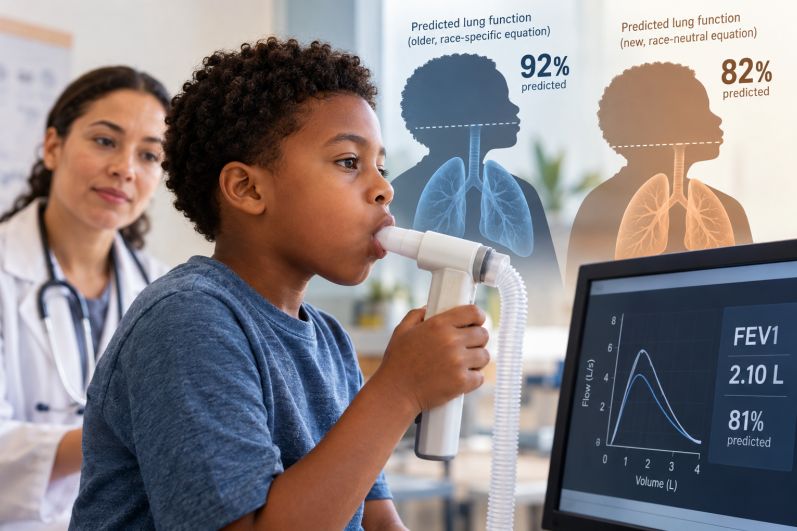
A change in how lung function is calculated could alter asthma treatment for thousands of Black children
A child takes a deep breath and blows as hard as possible into a spirometer. The machine records how much air comes out during the first second, one of the most common measurements used to evaluate asthma.
The number itself seems objective. But deciding whether that number is “normal” is more complicated.
For decades, lung-function measurements have been compared with predicted values that could differ according to a patient’s race or ethnicity. A Black child and a White child of the same age, sex and height could therefore have the same measured airflow but receive different interpretations of what that number meant.
Now that practice is being reconsidered.
A study published in the Journal of Allergy and Clinical Immunology examined what would happen if children with asthma were evaluated using newer equations that do not require clinicians to select a patient’s race. Among Black children, the consequences were substantial. About one in four moved into a worse asthma-control category, and among those eligible for additional inhaled corticosteroid treatment, 18 percent would have been recommended a higher medication step.
Nothing about the children’s lungs had changed. Only the definition of what their lung function was expected to be had changed.
The findings expose an uncomfortable problem hidden inside one of medicine’s most familiar measurements: sometimes the line between “normal” and “abnormal” depends partly on how normal was defined in the first place.
How Race Became Part of a Breathing Test
Spirometry is deceptively simple. A person inhales deeply and then exhales forcefully into a machine. One of the most important measurements is FEV1, the volume of air expelled during the first second. But physicians do not usually interpret FEV1 by looking at the raw volume alone. The measurement is compared with a predicted value based on characteristics such as age, height and sex.
Race historically entered that calculation as well.
Population studies had found average differences in measured lung volumes among racial and ethnic groups. Reference equations were therefore developed that incorporated those differences. Under commonly used equations, expected lung function for Black individuals was lower than that for White individuals with otherwise similar characteristics.
The approach was intended to make comparisons more accurate. But it rested on a much larger assumption: that population differences associated with race should be built into the definition of normal lung function. That assumption has increasingly been questioned.
Race is not a precise biological measurement. Differences in lung function among populations can reflect a complicated mixture of ancestry and body proportions as well as childhood nutrition, air pollution, housing conditions, environmental exposures, socioeconomic circumstances and other influences accumulated across a lifetime.
When those differences are incorporated into a clinical equation, the equation cannot determine why they exist. It simply treats them as expected. That distinction matters because an environmentally or socially influenced reduction in lung function could potentially be normalized rather than recognized as impairment.
In 2023 the American Thoracic Society recommended moving away from race-specific interpretation of pulmonary-function tests and toward race-neutral equations. The question then became: Would changing the equation actually change patient care?
More Than 2,000 Children Offered an Answer
Cynthia Visness and her colleagues revisited data from 2,076 children and adolescents who had participated in four major urban asthma studies conducted through the Inner-City Asthma Consortium. The average participant was about 11 years old. Nearly 62 percent identified as Black, approximately 30 percent as Hispanic, and the remainder identified as mixed or other races.
These children provided an unusually useful population in which to study the issue because their asthma treatment had been guided by standardized algorithms. Lung function was one of the factors used to determine how well asthma was controlled and whether medication should be increased.
The researchers recalculated the children's spirometry using two different systems.The older Global Lung Function Initiative 2012 equations incorporated race and ethnicity. The newer GLI Global 2022 equations use a race-neutral approach.
For Black children, the difference was striking. Their average FEV1 changed from 92.1 percent predicted under the race-specific equations to 81.9 percent predicted under the race-neutral equations. The children had not blown any differently into the machine. Their actual FEV1 measurements had not changed. Only the reference against which those measurements were judged had changed. Yet a difference of roughly 10 percentage points can matter greatly when lung function helps determine whether asthma appears adequately controlled.
The Same Lungs, A Different Treatment Decision
Once the race-neutral equations were applied, approximately 25 percent of Black children moved into a worse asthma-control category. More importantly, the mathematical change could have altered treatment.
Among Black children who were not already receiving the highest permitted dose of inhaled corticosteroids, 18 percent would have been assigned a higher medication step at their initial study visit. The corresponding changes among Hispanic children and children classified as mixed or other races were much smaller.
The implication is not that every Black child with a lower recalculated FEV1 should automatically receive more medication. Asthma treatment is considerably more complicated than a single spirometry measurement.
Instead, the study demonstrates something more fundamental: race-based reference equations could make reduced lung function appear less abnormal in some Black children.
Imagine two children whose lungs produce similar measurements. If the expected value for one child is lowered because that child is Black, the same physiological impairment can appear less severe. That difference may seem mathematical, but once the number enters a treatment algorithm, mathematics becomes medicine.
Why “Normal” Is Not as Simple as It Sounds
Medical reference ranges often carry an aura of certainty. A laboratory result is either inside or outside the normal range. A blood pressure is high or it is not. Lung function is normal or abnormal. But most medical definitions of normal are statistical constructions.
Researchers collect measurements from populations, determine how those measurements vary and then build equations describing what is expected. The result can be enormously useful, but it inevitably reflects the population used to create it and the assumptions used to divide that population.
Spirometry makes this particularly visible. The newer race-neutral equations do not mean that every human being should have identical lung capacity. Lung size varies naturally among individuals, and age, sex, height and other characteristics remain important.
Nor are the new equations perfect. Some populations remain underrepresented in the datasets used to construct lung-function standards. Race-neutral equations also produce relatively broad ranges of expected lung function, which creates the possibility that some abnormalities could still be overlooked.
A spirometry number therefore cannot replace clinical judgment. Symptoms, previous asthma attacks, bronchodilator response, medication requirements and other evidence of airway disease still need to be considered together.
Changing the Equation Does Not Yet Prove Better Outcomes
The new study also has important limitations.The participants came largely from urban communities with substantial socioeconomic disadvantage. The findings therefore may not translate directly to every child with asthma. More importantly, the analysis shows how treatment recommendations would have changed, not whether changing those treatments would actually have prevented asthma attacks, hospitalizations or long-term loss of lung function.
That question requires prospective studies in which children are managed using the newer equations and followed over time. There is also a danger in replacing one overly simple interpretation with another. Race-neutral spirometry should not become an automatic instruction to prescribe more medication. A low FEV1 can have multiple causes, and asthma severity cannot be determined from one number alone.
The value of the study lies elsewhere. It shows how a seemingly small assumption embedded inside a medical calculation can travel all the way from a computer equation to a prescription.
What Happens When Medicine Changes Its Definition of Normal?
The debate over spirometry is part of a broader reassessment taking place across medicine. Race has historically been incorporated into calculations involving kidney function, lung function and other areas of clinical care. In each case, a similar question has emerged: when differences are observed among populations, should those differences automatically be treated as biological norms?
For childhood asthma, the answer has immediate consequences. Black children in the United States already experience a disproportionate burden of severe asthma outcomes. Against that background, a system that can make impaired lung function appear more normal deserves careful examination.
The Visness study does not establish that race-neutral spirometry will eliminate those disparities, nor does it prove that increasing medication on the basis of the new equations will improve outcomes.
What it does show is simpler and perhaps more consequential. A child’s lungs can produce exactly the same measurement, yet the medical meaning assigned to that measurement can change dramatically depending on the reference equation used.
As race-neutral spirometry becomes more widely adopted, the change represents more than an update to a formula. It forces medicine to reconsider a question that applies far beyond asthma:
When we call a biological measurement “normal,” are we describing human physiology, or are we sometimes describing the assumptions built into the way we chose to measure it?
Reference
1. Visness CM, Sorkness CA, Sorkness R, et al. Impact of race-based spirometry equations on guideline-based asthma management in clinical trials. J Allergy Clin Immunol. 2025;156(6):1752-1755. doi:10.1016/j.jaci.2025.08.012.
2. Bhakta NR, Bime C, Kaminsky DA, et al. Race and ethnicity in pulmonary function test interpretation: an official American Thoracic Society statement. Am J Respir Crit Care Med. 2023;207(8):978-995. doi:10.1164/rccm.202302-0310ST.
3. Bowerman C, Bhakta NR, Brazzale D, et al. A race-neutral approach to the interpretation of lung function measurements. Am J Respir Crit Care Med. 2023;207(6):768-774. doi:10.1164/rccm.202205-0963OC.
4. Moffett AT, Eneanya ND, Halpern SD, Weissman GE. Global, race-neutral reference equations and pulmonary function test interpretation. JAMA Netw Open. 2023;6(6).
5. Baugh AD, Shiboski S, Hansel NN, et al. Application of Global Lung Function Initiative Global spirometry reference equations across a large, multicenter pulmonary function laboratory population. Am J Respir Crit Care Med. 2024.