

When Allergy Cells Invade the Bladder, an Asthma Drug May Help
When bladder inflammation resembles infection or cancer
A disease that can hide behind familiar symptoms
A patient exhausted by pain, bleeding and sleepless nights
In the 2026 case report, a 44-year-old man with allergic rhinoconjunctivitis developed daily visible blood in his urine, severe pain above the bladder, urinary urgency and a persistent sensation of needing to urinate. His sleep was interrupted more than 10 times each night, and repeated hospitalizations were required.
Cystoscopy revealed widespread red, inflamed areas without the papillary growths often associated with bladder tumors. A biopsy showed as many as 100 eosinophils per high-power microscopic field, accounting for approximately 60 percent of the inflammatory cells. Cancer, bacterial infection and parasitic disease were excluded.
His total immunoglobulin E, or IgE, was elevated, but his blood eosinophil count was within the normal range. The contrast was striking: eosinophils were densely concentrated in the bladder even though no obvious excess was detected in the circulation.
Antibiotics and the antihistamine cetirizine did not provide meaningful relief. Dexamethasone temporarily improved his symptoms, but they quickly returned when the corticosteroid was stopped. Continued steroid exposure also caused adrenal suppression, a complication in which the body’s natural production of cortisol is reduced.
Redirecting an asthma treatment toward the bladder
Because conventional treatments had failed and more invasive procedures were being considered, off-label treatment with benralizumab was started. Off-label use means that a medication approved for one disease is prescribed for another condition on the basis of clinical judgment and available evidence.
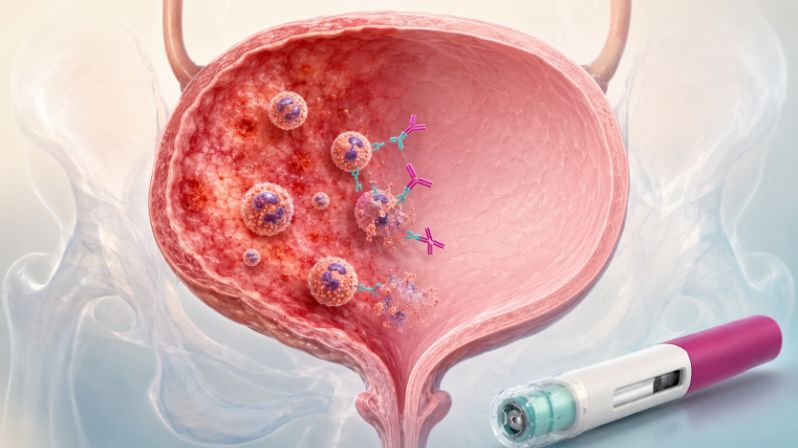
Benralizumab binds to the alpha subunit of the interleukin-5 receptor, or IL-5Rα, found on eosinophils. This binding marks the cells for removal by other components of the immune system. Instead of broadly suppressing immunity, as corticosteroids do, the medication is designed to deplete the eosinophils responsible for tissue inflammation.
The patient received a 30-milligram injection every four weeks for the first three months, followed by an injection every eight weeks, a schedule commonly used for severe eosinophilic asthma. Oral corticosteroids were discontinued after the first month.
After more than a year, visible blood in the urine and bladder tenesmus had completely resolved. Nighttime urination decreased from more than 10 episodes to approximately one per night, allowing far more continuous sleep. No adverse events were reported during follow-up.
Why the normal blood count matters
One of the most informative aspects of the case was the absence of peripheral eosinophilia. Blood eosinophil counts are frequently used to identify eosinophilic inflammation and to help select biologic treatments for diseases such as asthma. But eosinophils do not always remain in the bloodstream. They may be recruited into an organ, where inflammation can continue despite a normal circulating count.
This distinction between blood and tissue has practical consequences. If eosinophilic cystitis is suspected, a normal blood count should not be used to dismiss the diagnosis. Symptoms, cystoscopic findings and, most importantly, the bladder biopsy provide a more direct picture of what is occurring inside the organ.
The case also suggests that tissue eosinophils may remain treatable even when a blood-based eosinophil signal is absent. That possibility is supported by an earlier report of a woman without peripheral eosinophilia whose symptoms and bladder eosinophil infiltration improved after benralizumab treatment. Other cases have also described clinical or microscopic remission following benralizumab, although the patients and dosing schedules have varied.
A small but growing biologic treatment record
Benralizumab is not the only eosinophil-targeting medication being investigated for this disorder. Mepolizumab blocks IL-5 itself rather than its receptor, reducing signals that support eosinophil production and survival. Improvement has been reported in patients with difficult-to-treat eosinophilic cystitis, including two cases described in 2024.
These reports create a biologically plausible treatment pattern: when eosinophils dominate the bladder biopsy and standard therapy fails, blocking the IL-5 pathway may reduce the cells driving the inflammation. Such treatment could potentially reduce corticosteroid exposure and, in selected cases, postpone or prevent bladder surgery.
However, all published evidence remains limited to individual cases or very small case series. No controlled clinical trials have established how often these medications work, which patients are most likely to benefit, how long treatment should continue or whether symptoms recur after treatment is stopped.
Encouraging results, but important unanswered questions
The 2026 case did not include a post-treatment bladder biopsy because the patient declined another invasive procedure after several difficult hospital experiences. Clinical remission was well documented, but microscopic clearance of eosinophils was therefore not confirmed. In addition, an absence of side effects in one patient cannot establish the long-term safety of the treatment for this condition.
Benralizumab should consequently be viewed as a promising, highly specialized option rather than a proven standard therapy for eosinophilic cystitis. Its use would require collaboration among urologists, allergists or immunologists and pathologists, particularly because infection and cancer must be excluded before immune-targeting treatment is considered.
For patients with severe, biopsy-confirmed disease who cannot tolerate corticosteroids or continue to worsen despite treatment, biologic therapy may provide a less invasive path forward. The broader lesson is equally important: inflammation within an organ can remain active even when routine blood measurements appear reassuring. Sometimes the clearest evidence of immune disease is found not in the bloodstream, but in the tissue being injured.
Reference
1. Ruiz de Galarreta Beristain M, Audicana Berasategui MT, Bernedo Belar N, Mena Ruiz C, Moreno Nieto V and Uriel Villate O (2026) Eosinophilic cystitis refractory to multiple treatments with good response to benralizumab: case report. Front. Allergy 7:1890965. doi: 10.3389/falgy.2026.1890965
2. van den Ouden D. Diagnosis and management of eosinophilic cystitis: a pooled analysis of 135 cases. Eur Urol. 2000;37(4):386-394. doi:10.1159/000020183
3. Cooke WD, Cooke AJT. Successful treatment of eosinophilic cystitis with benralizumab. Urol Case Rep. 2020;33:101379. Published 2020 Aug 11. doi:10.1016/j.eucr.2020.101379
4. Konstantinou GN, Voukelatou V. Eosinophilic cystitis refractory to steroids successfully treated with benralizumab: A case report. Front Allergy. 2023;3:1055129. Published 2023 Jan 10. doi:10.3389/falgy.2022.1055129
5. Trefond L, Guy L, Darcha C, et al. Efficacy of Mepolizumab for the Treatment of Eosinophilic Cystitis: A Report of 2 Cases. J Investig Allergol Clin Immunol. 2024;34(3):202-204. doi:10.18176/jiaci.0954