

What Happens When You Stop an Antihistamine? Not All Withdrawal Reactions Are the Same
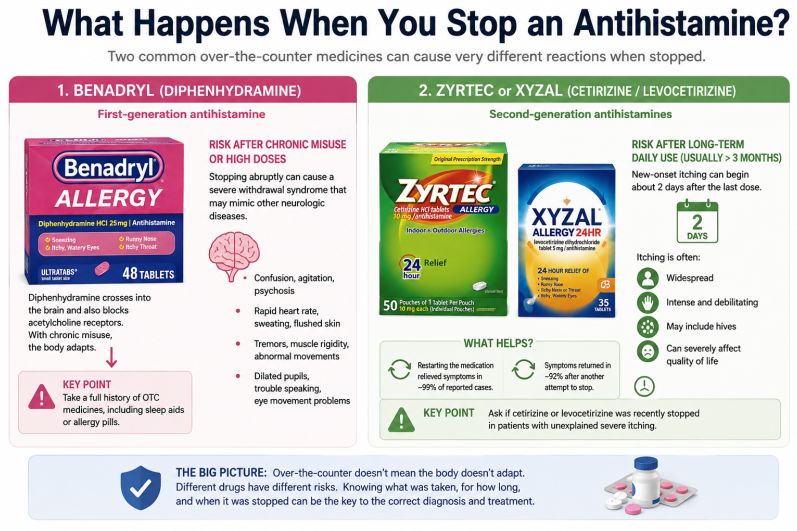
Benadryl, Zyrtec and Xyzal are familiar over-the-counter medicines, but reports of symptoms after stopping them reveal two very different ways the nervous and immune systems can respond to long-term antihistamine exposure
Benadryl Does Much More Than Block Histamine. The Older Antihistamine That Also Acts on the Brain
When Antihistamine Withdrawal Looks Like a Neurological Emergency
A Very Different Problem Can Follow Zyrtec or Xyzal
Cetirizine and levocetirizine belong to a newer generation of antihistamines. They generally produce fewer effects in the brain and much less anticholinergic activity than diphenhydramine.
Their discontinuation has been associated with a different and surprisingly specific phenomenon.
Intense itching can begin after the drug is stopped.
Reports of this reaction accumulated for years. An FDA analysis published in 2019 described 146 cases of pruritus after cetirizine discontinuation. Earlier cases had also been reported through the Netherlands Pharmacovigilance Centre Lareb.
The evidence eventually became strong enough that in 2025 the U.S. Food and Drug Administration announced that warnings about rare but severe itching after discontinuation would be added to cetirizine and levocetirizine labeling.
A subsequent FDA analysis published in The Journal of Allergy and Clinical Immunology: In Practice examined the phenomenon in greater detail.
Researchers identified 209 reports of new-onset itching after cetirizine or levocetirizine discontinuation between 2017 and 2023. The numbers themselves were small relative to the enormous use of these medications. The pattern within the reports, however, was difficult to ignore.
Two Days After the Last Pill, the Itching Begins
People in the FDA analysis had taken cetirizine or levocetirizine for a median of about 33 months before stopping. Then symptoms appeared quickly.
The median time from the final dose to the onset of itching was only two days. Most cases with known treatment histories occurred after more than three months of use. The itching could also be surprisingly severe.
It was frequently described as widespread, debilitating or highly distressing. Some people developed hives as well. The intensity could interfere with sleep, work and normal daily activities.
The FDA has emphasized that this reaction appears to be rare. Cetirizine and levocetirizine are used by millions of people, whereas the safety databases contain only hundreds of reports.
Adverse-event databases also cannot tell researchers exactly how frequently a reaction occurs. People who experience severe or unusual symptoms are more likely to submit reports than people who stop a medication without difficulty. But another feature of the data makes the association particularly intriguing.
The Stop-and-Restart Experiment
In medicine, one of the most useful clues that a drug is causing a symptom is what happens when exposure changes. A symptom appears when a medication is removed. It disappears when the medication is restored. Then it reappears when the medication is removed again.
Something remarkably close to that experiment has occurred unintentionally among people trying to stop cetirizine and levocetirizine. Many reported substantial improvement after restarting the antihistamine. But when another attempt was made to discontinue it, the itching frequently returned. This repeated sequence strengthens the suspected causal relationship.
It also raises a perplexing biological question. Why should removing an anti-itch medication make someone itch more than they did before taking it?
Histamine Receptors Are Not Simple On-Off Switches
To understand one possible explanation, it helps to reconsider what an antihistamine actually does. The conventional explanation is that antihistamines "block histamine." That is useful shorthand, but receptor biology is more complicated.
The H1 receptor can spontaneously move between active and inactive configurations. Histamine favors the active state, pushing signaling in one direction. Modern H1 antihistamines such as cetirizine and levocetirizine function as inverse agonists, stabilizing the receptor's inactive state and shifting signaling in the opposite direction.
When that process occurs every day for months or years, the biological system may adapt.
Changes in receptor expression or signaling have therefore been proposed as possible explanations for post-discontinuation itching. After the antihistamine disappears, the balance between active and inactive receptor signaling could theoretically shift, allowing histamine-mediated itch pathways to become temporarily more active.
It is an appealing hypothesis. It is also not yet a proven mechanism.
The FDA has stated that the biological basis of the reaction remains unknown. Human studies have not established a simple sequence in which H1 receptors change during long-term cetirizine use and then produce a predictable histamine "rebound" when treatment stops.
Itch itself is also much more complicated than histamine.
Sensory neurons in the skin communicate with mast cells, keratinocytes and other immune cells through numerous molecular signals. Some forms of chronic itching are barely responsive to antihistamines at all. A post-discontinuation reaction could therefore involve changes extending beyond the H1 receptor itself.
Is This Addiction?
The word withdrawal carries baggage. If stopping a medication causes symptoms and restarting it makes them disappear, it is easy to conclude that the drug must be addictive. That conclusion would be misleading, particularly for cetirizine and levocetirizine.
Physical adaptation, dependence and addiction are related but distinct concepts. The body routinely adjusts to medications. Blood-pressure drugs, corticosteroids and many medications acting on the nervous system can produce physiological adaptations during prolonged treatment. Abruptly removing some of them can temporarily disrupt the balance that developed while the medicine was present.
Addiction additionally involves characteristic behavioral processes, including compulsive use despite harmful consequences and powerful reinforcement or craving. No comparable evidence suggests that ordinary therapeutic use of cetirizine or levocetirizine produces addiction.
Diphenhydramine presents a somewhat different situation. Because of its central nervous system effects, misuse and dependence have been reported. But even there, the severe withdrawal case described in the medical literature should not be generalized to someone who occasionally takes a normal dose of Benadryl for allergies.
Would Tapering Solve the Problem?
If abruptly removing a medication causes symptoms, gradually reducing it seems like an obvious solution. Some reports suggest that tapering cetirizine or levocetirizine may help certain people eventually discontinue the medication. But the evidence remains limited.
There have not been adequate controlled trials comparing abrupt discontinuation with different tapering schedules. It is therefore unknown whether reducing the dose over several days, several weeks or even longer meaningfully lowers the risk.
Some reported patients required prolonged attempts before successfully stopping. Others continued to experience symptoms despite various interventions.
For now, no single scientifically validated tapering regimen can be recommended on the basis of these reports alone.
Someone who develops severe itching after stopping a long-term antihistamine should therefore discuss the problem with a health care professional rather than repeatedly stopping and restarting the medication without guidance.
The Medication Patients Forget to Mention
There is a broader lesson hidden inside both stories. When clinicians ask patients what medications they take, people tend to remember prescriptions. They may forget the cetirizine they buy in bulk, the nightly sleep aid containing diphenhydramine or the allergy tablet that has sat beside the toothbrush for five years.
Yet the human nervous and immune systems do not distinguish between prescription and nonprescription drugs. For someone presenting with unexplained severe itching, it may therefore be useful to ask whether cetirizine or levocetirizine was recently stopped.
For someone with an unusual combination of tremor, mental-status changes and autonomic symptoms, chronic or excessive diphenhydramine exposure may occasionally be an important clue.
And for patients, the medication list should include everything taken regularly, regardless of whether a prescription was required to obtain it.
What Everyday Antihistamines Can Teach Us
None of this means antihistamines should be feared. Cetirizine and levocetirizine remain widely used treatments for allergic rhinitis and chronic hives, and severe itching after discontinuation appears to be rare. Diphenhydramine withdrawal severe enough to resemble a neurological emergency has been described in the setting of chronic misuse, not ordinary occasional use. Instead, these observations reveal something more interesting about human physiology.
A drug does not simply enter the body, perform one task and disappear without consequence. Receptors change states. Neural networks compensate. Immune signals interact with sensory nerves. With repeated exposure, biological systems may adjust to the continued presence of a chemical signal.
Usually those adaptations remain invisible. Occasionally, they become apparent when the drug is removed.
Understanding why severe itching follows cetirizine or levocetirizine discontinuation in a small subset of people could eventually reveal more about how histamine receptors and itch circuits adapt during long-term treatment. Understanding diphenhydramine withdrawal may similarly illuminate the interactions among histamine, acetylcholine and other neurotransmitter systems.
For now, however, the practical message is considerably simpler: over-the-counter medicines are still medicines. When they are taken regularly for months or years, that history matters, including when the last pill was taken.
Reference
1. Saran JS, Barbano RL, Schult R, Wiegand TJ, Selioutski O. Chronic diphenhydramine abuse and withdrawal: A diagnostic challenge. Neurol Clin Pract. 2017;7(5):439-441. doi:10.1212/CPJ.0000000000000304
2. Konkel K, Lee JY, Jones SC, et al. New onset pruritus following discontinuation of cetirizine or levocetirizine. J Allergy Clin Immunol Pract. 2026;14(3):725-728. doi:10.1016/j.jaip.2025.11.040
3. Chung AH, La Grenade L, Harinstein LM. Pruritus after discontinuation of cetirizine. Ther Adv Drug Saf. 2019;10:2042098619859996. Published 2019 Jul 5. doi:10.1177/2042098619859996
4. Ekhart C, van der Horst P, van Hunsel F. Unbearable Pruritus After Withdrawal of (Levo)cetirizine. Drug Saf Case Rep. 2016;3(1):16. doi:10.1007/s40800-016-0041-9
5. US Food and Drug Administration. FDA requires warning about rare but severe itching after stopping long-term use of oral allergy medicines cetirizine or levocetirizine (Zyrtec, Xyzal, and other trade names). Published May 16, 2025. Accessed August 19, 2026.