

Asthma’s New Frontier: Can the Disease Enter Remission?
For generations, people with severe asthma have been taught to think in terms of management rather than recovery. The goal was pragmatic: avoid the emergency room, keep symptoms tolerable and try not to lose too much lung function over time. Even patients doing “well” often lived with a quiet background hum of inflammation, interrupted sleep, rescue inhalers in pockets and the looming possibility of the next attack.
From “Control” to Something Deeper
For decades, asthma care revolved around the idea of control. Doctors measured how often patients wheezed, how frequently they needed rescue inhalers and whether they experienced dangerous exacerbations requiring steroids or hospitalization.
That framework saved lives. Yet it also carried an implicit assumption: asthma was a permanent condition that could be suppressed but not fundamentally altered. The newer remission model challenges that assumption. Instead of asking whether symptoms are merely reduced, specialists now ask whether the disease has become biologically quiet enough that its day-to-day footprint nearly disappears.
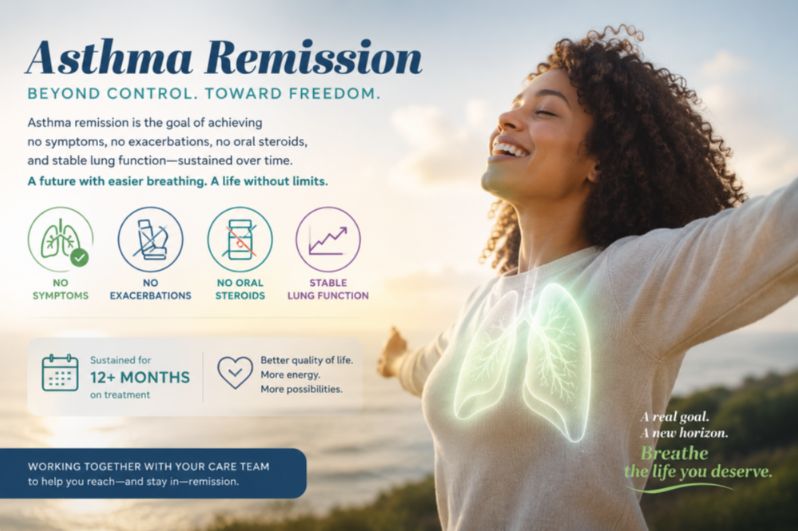
According to the SANI consensus, clinical remission requires several conditions to persist simultaneously for at least a year: no asthma attacks, no oral steroid use, minimal symptoms and stable lung function. That may sound modest. For severe asthma patients, however, it can represent a radical transformation.
Why Steroids Became the Central Battlefield
One striking feature of the remission definition is its emphasis on eliminating oral corticosteroids such as prednisone. For many severe asthma patients, these medications have functioned as both lifeline and burden. Steroids can suppress airway inflammation dramatically, but long-term use often extracts a heavy biological price: diabetes, osteoporosis, cataracts, weight gain, insomnia, hypertension and mood changes among them.
In some patients, the disease itself becomes intertwined with the complications of the treatment. The SANI group therefore made steroid freedom a mandatory requirement for remission. A patient still dependent on repeated prednisone bursts, even if otherwise improved, would not qualify. This reflects a broader change occurring across medicine: increasingly, successful treatment is defined not only by suppressing disease but also by reducing treatment toxicity itself.
The Biologic Revolution
The idea of remission would have seemed unrealistic two decades ago. Its emergence is tied closely to the rise of biologic drugs that target specific immune pathways driving asthma inflammation. Unlike older therapies that broadly dampened the immune system, biologics act with greater precision. Some block eosinophils, inflammatory cells implicated in many forms of severe asthma. Others interrupt signaling molecules such as interleukins or IgE antibodies involved in allergic inflammation.
For some patients, the results have been dramatic. Individuals once hospitalized repeatedly can experience years without severe attacks. Chronic prednisone users may taper off steroids entirely. Patients who previously avoided exercise regain stamina and sleep through the night without coughing or chest tightness. Not every patient responds equally, however. Severe asthma is not a single disease but a collection of overlapping inflammatory patterns shaped by genetics, allergies, infections, pollution exposure, obesity and immune biology.
That variability is one reason the SANI framework divides outcomes into “partial” and “complete” remission rather than using a simple yes-or-no definition.
Asthma Beyond the Airways
The remission movement also reflects a changing scientific view of asthma itself. Traditionally, asthma was seen primarily as episodic narrowing of the airways, a mechanical problem of breathing tubes tightening and swelling. But research increasingly portrays it as a systemic inflammatory condition with consequences extending beyond wheezing alone.
Even low-grade airway inflammation may affect sleep quality, concentration, exercise tolerance and energy levels. Chronic inflammation can also remodel lung tissue over time, gradually reducing pulmonary reserve even when symptoms appear relatively controlled.
This deeper understanding has shifted the therapeutic mindset. Physicians are becoming less satisfied with merely preventing catastrophic attacks and more interested in preserving long-term lung health and overall physiologic stability.In that sense, remission represents not just a new clinical definition but a philosophical change in medicine’s ambitions.
Is Remission the Same as a Cure?
Not yet. Most patients who achieve remission continue taking biologic therapies or inhaled medications. Researchers therefore describe the state as “clinical remission on treatment. ”A true cure, remaining symptom-free after all therapies are withdrawn, remains rare in severe asthma.
Still, even remission on treatment may profoundly alter a patient’s life. Someone who once organized every day around breathing limitations may begin to live with a degree of normalcy previously unimaginable. And that possibility may be the most important shift of all.
For much of modern medical history, severe asthma was framed as an inevitably progressive disease interrupted only temporarily by medication. The emerging remission framework suggests something more hopeful: that in at least some patients, chronic airway inflammation can be driven into prolonged quietude, allowing the lungs, and perhaps the person attached to them, to reclaim a version of normal life.
Reference
1. Canonica GW, Blasi F, Carpagnano GE, et al. Severe Asthma Network Italy Definition of Clinical Remission in Severe Asthma: A Delphi Consensus. J Allergy Clin Immunol Pract. 2023;11(12):3629-3637. doi:10.1016/j.jaip.2023.07.041
2. Menzies-Gow A, Bafadhel M, Busse WW, et al. An expert consensus framework for asthma remission as a treatment goal. J Allergy Clin Immunol. 2020;145(3):757-765. doi:10.1016/j.jaci.2019.12.006
3. Canonica GW, Spanevello A, de Llano LP, et al. Is asthma control more than just an absence of symptoms? An expert consensus statement. Respir Med. 2022;202:106942. doi:10.1016/j.rmed.2022.106942
4. Holguin F, Cardet JC, Chung KF, et al. Management of severe asthma: a European Respiratory Society/American Thoracic Society guideline. Eur Respir J. 2020;55(1):1900588. Published 2020 Jan 2. doi:10.1183/13993003.00588-2019
5. Canonica GW, Bagnasco D, Bondi B, et al. SANI clinical remission definition: a useful tool in severe asthma management. J Asthma. 2024;61(12):1593-1600. doi:10.1080/02770903.2024.2376919