

The Air at Home: How a Child’s Indoor “Exposure Burden” May Shape Pneumonia Risk
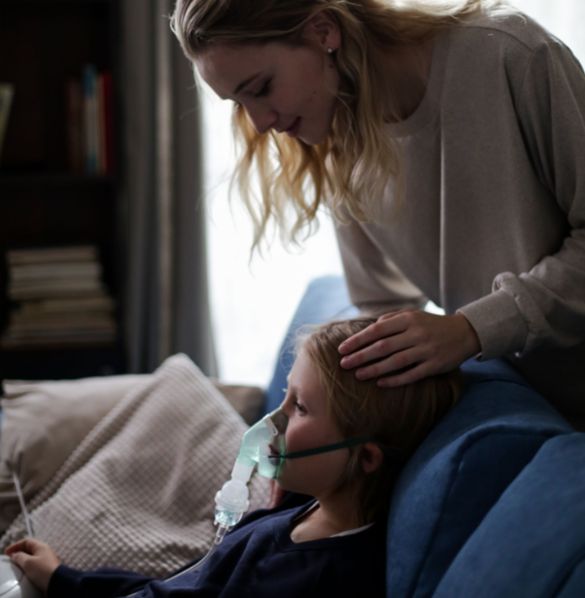
A preschooler wakes after spending eight or ten hours in a closed bedroom. The air may look perfectly clean. But invisible particles have accumulated overnight.
A Virus Does Not Enter an Empty Lung
We often imagine pneumonia as a simple event. A virus or bacterium enters the respiratory tract, multiplies and causes illness. Biology is rarely so simple. A respiratory pathogen enters an airway that already has a history. That airway may have been exposed repeatedly to tobacco smoke, pet allergens, cooking emissions, outdoor pollution, fragrances or poor ventilation. In some children, particularly those with asthma or an inherited tendency toward allergic disease, the airway may already be inflamed or unusually reactive before an infection begins.
This distinction may be important. An infection arriving in a relatively healthy airway may produce one clinical course. The same infection arriving in an airway already affected by inflammation, mucus production or bronchial hyperresponsiveness may produce another.
The Haikou study did not directly measure airway inflammation or prove this mechanism. But children with a family history of allergic disease had approximately 42 percent higher odds of a reported history of pneumonia. That association suggests that the child's underlying biology may matter as much as the environment itself.
The better question may not be simply, “What infection did this child catch?” It may also be, “What was the condition of the airway when the infection arrived?”
The Concept of Total Indoor Exposure Burden
Environmental research often separates exposures into categories. Scientists study tobacco smoke, mold, pets, cooking pollution and outdoor particulate matter individually.
Children do not breathe them individually. They breathe mixtures.
Consider a child with allergic susceptibility living in a tightly sealed home. The family has a dog or cat. A parent smokes. Cooking produces combustion particles. Fragranced products are used throughout the house. Moisture accumulates in bathrooms or bedrooms. The heating and cooling system continuously recirculates indoor air while little fresh air enters.
Each exposure may contribute only part of the respiratory burden. Together, however, they create the child's total indoor exposure burden. This concept may be particularly relevant to asthma and allergic disease. A child with sensitive airways may not respond to environmental exposures in the same way as a child without airway inflammation. Repeated low-level exposure could potentially maintain a background state of irritation or inflammation that becomes clinically obvious only when a respiratory infection adds another stressor.
The Haikou study did not calculate a formal cumulative exposure score. But its findings support the need to think beyond the traditional search for a single culprit. In real homes, exposures overlap.
Pets Change the Biology of a Home
Among the potentially modifiable factors identified in the study, furry pets showed the strongest association with pneumonia. Children living with furry animals had approximately 71 percent higher odds of having a reported history of pneumonia. This finding requires careful interpretation. The study does not prove that dogs or cats cause pneumonia. Research on early pet exposure and immune development is complex, and some studies have suggested potential protective effects against certain allergic outcomes in specific populations.
But pets unquestionably change the indoor environment. Dogs and cats continuously release microscopic biological material. Allergens derived from skin particles and saliva can become airborne or accumulate in carpets, sofas, mattresses and clothing. These materials may later be stirred back into the air through ordinary household activity.
For most children, this may not result in obvious illness. For a sensitized child or one with asthma, however, persistent allergen exposure may contribute to airway inflammation. This leads to an important distinction: the same pet exposure may not have the same biological effect in every child.
A family with a healthy, asymptomatic child may face a different situation from a family whose child has recurrent wheezing, chronic nasal inflammation, persistent cough or repeated respiratory illnesses. Rather than treating pet ownership as universally harmful or harmless, the more useful question may be whether a particular child's airway is showing evidence of vulnerability in a particular indoor environment.
Tobacco Smoke Adds to the Airway Burden
Paternal smoking was associated with approximately 25 percent higher odds of pneumonia in the Haikou study. Unlike the complex story surrounding pets, the evidence regarding tobacco smoke is much clearer. Tobacco smoke is a well-established respiratory hazard for children.
Young lungs are still developing. Repeated smoke exposure can irritate airway surfaces and interfere with respiratory defenses. Children may inhale secondhand smoke directly, but exposure can also involve tobacco residues deposited on clothing, furniture, walls and carpets.
The important point is that tobacco smoke does not exist in isolation. A smoke-exposed child may also have asthma. The home may also contain pet allergens. Ventilation may be poor. Respiratory viruses may circulate through school or daycare. Each factor becomes part of the child's cumulative respiratory environment. Removing one major source, especially tobacco smoke, can therefore reduce a meaningful part of the total burden, even if other exposures remain.
Ventilation May Be the Missing Variable
Haikou offers an intriguing natural experiment.The city has a tropical monsoon climate, and many residents can keep windows open throughout much of the year. The study found a pneumonia prevalence of 20.4 percent, lower than rates reported in several studies from other Chinese cities.
The researchers suggested that year-round natural ventilation may be one possible explanation. The idea deserves attention because modern buildings are often designed around temperature control rather than respiratory health. A room can feel cool and comfortable while still being poorly ventilated.
Air conditioning is not necessarily ventilation. Many systems recirculate indoor air. Without sufficient outdoor-air exchange or effective filtration, pollutants generated inside a building can accumulate. This includes particles from smoking and cooking, biological materials from pets, and respiratory aerosols released by infected occupants. Ventilation changes the equation by dilution.
A pollutant continuously released into a poorly ventilated room can reach a much higher concentration than the same pollutant released into a space with adequate clean-air exchange. This does not mean that opening windows is always appropriate. In areas affected by wildfire smoke, traffic pollution, industrial emissions or high pollen counts, unfiltered outdoor air may worsen respiratory exposure.
The goal is not simply more outside air. The goal is more clean air.
Fresh-Air Filtration and the Possibility of Prevention
Perhaps the most promising finding in the study was the association with fresh-air filtration systems. Children living in homes equipped with these systems had approximately 43 percent lower odds of pneumonia. This finding should not be interpreted as proof that installing a particular device will prevent pneumonia. Families with advanced ventilation systems may differ in income, housing quality, education and other health-related behaviors.
Nevertheless, the association points toward an area of prevention that deserves greater attention. A comprehensive indoor air strategy has several components: reducing pollution at its source, exhausting contaminants where they are generated, bringing in appropriate amounts of outdoor air and filtering airborne particles.
No single intervention can do everything. A portable particle filter may reduce airborne particles but cannot replace ventilation. Opening windows can improve air exchange but may introduce pollen or outdoor pollution. Mechanical ventilation can increase fresh-air delivery but must be properly designed and maintained. The larger principle is simple: children need an adequate supply of clean air, not merely temperature-controlled air.
This principle may be especially important in schools and childcare centers, where young children spend hours together and respiratory infections can spread rapidly.
Allergic Airways May Need More Protection
One of the most clinically important implications of the Haikou study is that environmental recommendations may need to be personalized.Children with a family history of allergic disease had higher odds of pneumonia. This does not establish that allergy causes infection, but it raises the possibility that allergic susceptibility identifies a population with more vulnerable airways.
Asthma, allergic rhinitis and recurrent respiratory infections often overlap clinically in young children. Viral infections can provoke wheezing. Allergic inflammation can increase mucus production and airway sensitivity. Poorly controlled airway disease may make respiratory illnesses appear more frequent or more severe.
The relationships are complicated and still being studied. But from a practical standpoint, a child with recurrent cough, wheezing, nighttime symptoms or repeated respiratory diagnoses may benefit from evaluation of both the child and the environment.
Treating airway inflammation while leaving a major indoor exposure burden unchanged may be incomplete. Likewise, improving indoor air without recognizing uncontrolled asthma may also be incomplete. Respiratory health sits at the intersection of host susceptibility, airway inflammation, infection and environment.
The Home as a Respiratory Ecosystem
The Haikou study has important limitations. It was cross-sectional, so it cannot establish that the environmental factors preceded or caused pneumonia. Pneumonia history depended on parental reporting of physician diagnoses. Vaccination and nutritional status were not fully incorporated into the analysis, and families who participated may have differed from those who did not.
Still, the study contributes to a broader change in how respiratory disease is understood. The lungs do not exist separately from the buildings in which people live. A young child may spend most of each day inside a home, school, daycare center or vehicle. In each place, the child continuously inhales a mixture determined by human behavior, building design, ventilation, filtration and environmental sources.
Some children will tolerate this burden better than others. A child with asthma, allergic susceptibility or already inflamed airways may represent the respiratory equivalent of a smaller reserve capacity: an additional infection or pollution episode may have a greater clinical impact. This does not mean that every respiratory infection can be prevented by changing the indoor environment. Nor does it mean that parents should fear ordinary homes or household pets.
It means that respiratory disease should be understood as an interaction. A virus does not enter an empty lung. It enters an airway shaped by genetics, immune development, previous infections, allergic inflammation and thousands of hours of breathing the air of a particular environment.
The most useful question, therefore, may not be whether one object in the home is dangerous. It may be:
"What is the total burden this child's airway is being asked to handle, and what can reasonably be removed, diluted, filtered or treated?"
For a developing lung, clean air is not simply a matter of comfort. It may be part of preventive medicine.
Reference
1. Wang S, Wu Q, Hu Y, et al. Indoor environmental factors and pneumonia in preschool children in Haikou China. Sci Rep. 2026;16(1):16624. Published 2026 Mar 10. doi:10.1038/s41598-026-42519-7
2. Zhuge Y, Qian H, Zheng X, et al. Residential risk factors for childhood pneumonia: A cross-sectional study in eight cities of China. Environ Int. 2018;116:83-91. doi:10.1016/j.envint.2018.03.022
3. Shi W, Liu C, Annesi-Maesano I, et al. Ambient PM2.5 and its chemical constituents on lifetime-ever pneumonia in Chinese children: A multi-center study. Environ Int. 2021;146:106176. doi:10.1016/j.envint.2020.106176
4. Qu F, Weschler LB, Zhang Y, Spengler JD. Childhood pneumonia in Beijing: Associations and interactions among selected demographic and environmental factors. Environ Res. 2023;231(Pt 3):116211. doi:10.1016/j.envres.2023.116211
5. McAllister DA, Liu L, Shi T, et al. Global, regional, and national estimates of pneumonia morbidity and mortality in children younger than 5 years between 2000 and 2015: a systematic analysis. Lancet Glob Health. 2019;7(1):e47-e57. doi:10.1016/S2214-109X(18)30408-X