

How Cigarette Smoke Reprograms the Immune System, and Makes Asthma Harder to Control
For decades, physicians have known that people with asthma who smoke tend to fare worse than those who do not. They experience more symptoms, suffer more frequent flare-ups, lose lung function more rapidly, and often respond less effectively to standard treatments. Yet one question has remained surprisingly difficult to answer: What exactly does cigarette smoke do inside the lungs that makes asthma so much harder to control?
When Asthma Changes Its Identity
Asthma is often portrayed as a single disease driven by allergies. In this familiar version, pollen, dust mites, pet dander, or mold trigger an immune response dominated by eosinophils and type 2 inflammation. Many of today's most successful biologic therapies are designed to target this pathway.
But asthma is remarkably diverse. Not all patients fit the allergic mold, and smoking appears to push asthma into a very different inflammatory state.
The researchers found that smokers with asthma had elevated numbers of immune cells known as type 3 innate lymphoid cells, or ILC3s. These cells belong to the body's innate immune system, the branch responsible for rapid responses to injury and environmental threats.
Unlike the cells that drive classic allergic asthma, ILC3s promote a form of inflammation associated with tissue injury, neutrophil recruitment, and chronic immune activation. In smokers, these cells appeared to become major players in the disease process.
The more ILC3s present, the worse a patient's asthma tended to be.
The Immune System Remembers Smoke
Perhaps the most intriguing discovery was that many of these ILC3s behaved like memory cells.
Traditionally, immunologic memory has been considered the domain of T cells and B cells, which remember previous infections and allow the body to respond more rapidly upon re-exposure. Over the past decade, however, scientists have learned that certain innate immune cells can also acquire a form of memory, a phenomenon often called "trained immunity."
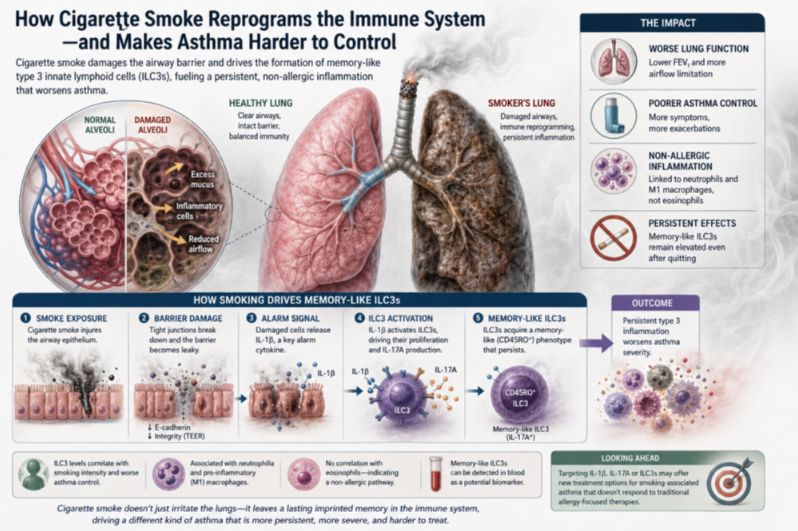
In the study, cigarette smoke appeared to transform ILC3s into a long-lived activated state marked by the protein CD45RO. These memory-like cells produced large amounts of IL-17A, a potent inflammatory molecule implicated in chronic lung disease and severe asthma.
What surprised researchers most was their persistence. Elevated numbers of these memory-like ILC3s were found not only in active smokers but also in former smokers. In effect, the immune system seemed to retain a biological memory of smoking exposure.
This finding raises the possibility that some of the long-term consequences of smoking may result not simply from structural damage to the lungs but from lasting changes in immune behavior.
The Airway Barrier Under Attack
The process begins with one of cigarette smoke's earliest targets: the airway lining.
The lungs are coated with a thin layer of epithelial cells that serves as a protective barrier between the outside world and the body's internal tissues. These cells are tightly connected, forming a defensive wall against pollutants, microbes, and airborne irritants.
Cigarette smoke weakens this barrier. The researchers found that smoke exposure reduced levels of E-cadherin, a protein that helps neighboring epithelial cells remain attached to one another. As these cellular connections deteriorate, the airway becomes increasingly permeable and vulnerable.
Imagine a brick wall whose mortar is slowly dissolving. The wall may still stand, but harmful substances can begin slipping through the cracks. This barrier breakdown appears to be one of the earliest steps in a cascade that ultimately reshapes immune function.
A Molecular Alarm System
Damaged airway cells do not suffer in silence.
When injured by cigarette smoke, they release distress signals that alert the immune system. One of the most important of these signals is a cytokine called interleukin-1 beta (IL-1β). The study demonstrated that cigarette smoke dramatically increased IL-1β production within airway tissues. This molecule acts as a powerful alarm signal, recruiting and activating inflammatory cells.
For ILC3s, IL-1β serves as both fuel and instruction manual. Exposure to IL-1β stimulates these cells to multiply and produce IL-17A, further amplifying inflammation. The result is a self-perpetuating cycle in which smoke damages the airway, damaged cells release inflammatory signals, and activated immune cells intensify the injury.
Over time, the cycle may help explain why smokers often develop a form of asthma that is more severe and more resistant to treatment.
A Different Kind of Inflammation
One of the most important clinical implications of the study is that smoking-associated asthma may not follow the rules of classic allergic disease.
The researchers found no meaningful relationship between ILC3 levels and eosinophils, the hallmark cells of allergic asthma. Instead, higher ILC3 counts were linked to increased neutrophils and inflammatory macrophages, both indicators of a different immune pathway.
This distinction may help explain why some smokers with asthma continue to struggle despite receiving therapies that effectively suppress allergic inflammation. Their disease may be driven by a different biological engine altogether. Rather than being dominated by type 2 allergic responses, smoking-related asthma may increasingly depend on type 3 inflammatory pathways involving IL-1β, IL-17A, and ILC3s.
Why Former Smokers May Continue to Struggle
Many people assume that once smoking stops, the lungs gradually return to normal. While smoking cessation remains one of the most beneficial actions a person can take for respiratory health, the new findings suggest the story is more complicated.
The persistence of memory-like ILC3s implies that the immune system may continue operating under instructions learned during years of smoke exposure.
This does not mean recovery is impossible. Lung function often improves after quitting, and ongoing injury is reduced dramatically. But it does suggest that some immune changes may linger for years, potentially contributing to continued symptoms even after smoking cessation.
The lungs may heal, but parts of the immune system may remember.
A New Frontier for Asthma Treatment
The discovery of memory-like ILC3s points toward a new generation of therapeutic targets.
Current biologic treatments primarily focus on allergic pathways involving IgE, IL-4, IL-5, and IL-13. These therapies have transformed care for many patients but are often less effective in smokers and former smokers.
Future treatments may instead target the pathways highlighted in this study, including IL-1β signaling, IL-17A production, or the ILC3 population itself.
Researchers also envision using circulating memory-like ILC3s as biomarkers to identify patients with smoking-driven asthma and guide more personalized treatment strategies. Although such approaches remain experimental, they reflect a growing recognition that asthma is not one disease but many diseases sharing similar symptoms.
The Lasting Legacy of Smoke
The study reveals a striking biological reality: cigarette smoke leaves behind more than tar deposits and damaged airways. It can alter the behavior of the immune system itself.
By disrupting the airway barrier, triggering inflammatory alarm signals, and generating memory-like immune cells, smoking appears to create a durable inflammatory program that continues to influence lung health long after exposure ends.
The findings underscore an emerging theme in modern immunology, that the immune system records the environmental experiences of a lifetime. In the case of cigarette smoke, that memory may become part of the disease, helping explain why smoking-related asthma often proves more persistent, more severe, and more difficult to treat than physicians once understood.
Reference
1. Ham J, Kim J, Sohn KH, et al. Cigarette smoke aggravates asthma by inducing memory-like type 3 innate lymphoid cells. Nat Commun. 2022;13(1):3852. Published 2022 Jul 4. doi:10.1038/s41467-022-31491-1
2. Ham J, Lim M, Kim D, Kim HY. Memory-like innate lymphoid cells in the pathogenesis of asthma. Front Immunol. 2022;13:1005517. Published 2022 Nov 17. doi:10.3389/fimmu.2022.1005517
3. Yamasaki A, Okazaki R, Harada T. Neutrophils and Asthma. Diagnostics (Basel). 2022;12(5):1175. Published 2022 May 8. doi:10.3390/diagnostics12051175
4. Kim J, Ryu S, Kim HY. Innate Lymphoid Cells in Tissue Homeostasis and Disease Pathogenesis. Mol Cells. 2021;44(5):301-309. doi:10.14348/molcells.2021.0053
5. Ham J, Kim J, Choi S, et al. Interactions between NCR+ILC3s and the Microbiome in the Airways Shape Asthma Severity. Immune Netw. 2021;21(4):e25. Published 2021 Jul 22. doi:10.4110/in.2021.21.e25