

The Forgotten Fungi in a Baby’s Gut: Could They Influence Allergy Risk Years Later?
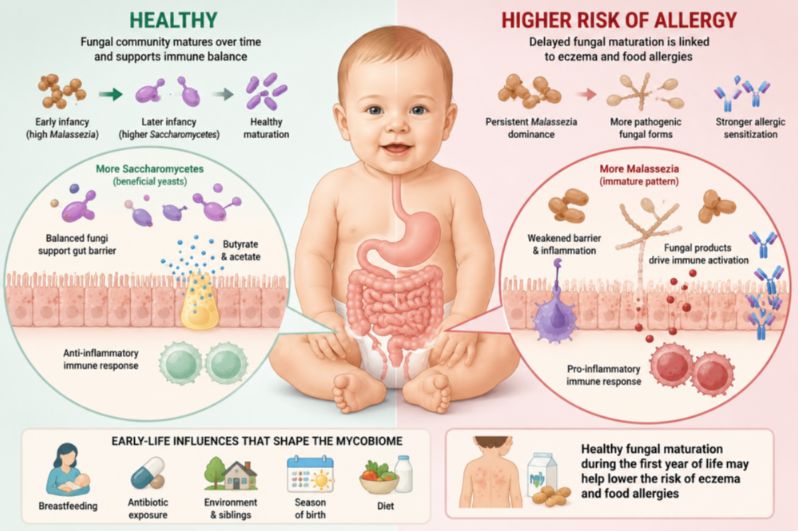
For years, the story of the infant microbiome has been told largely through bacteria. Scientists have linked early bacterial communities to everything from digestion and obesity to asthma and immune development. But another group of microscopic residents has remained largely in the shadows: fungi.
The Microbes We Forgot to Study
A Predictable Journey Through the First Year of Life
Researchers analyzed stool samples from more than 1,400 children participating in Canada's CHILD Cohort Study, one of the largest investigations of childhood development and environmental influences on health. Rather than finding a random assortment of fungal species, they discovered something surprisingly orderly. The infant gut mycobiome appeared to mature along a predictable timeline, much like a child learns to crawl before walking and walk before running.
One fungal group, Malassezia, dominated early infancy. Best known as a common resident of human skin, Malassezia was abundant in young infants but declined dramatically over time. At the same time, another group of fungi called Saccharomycetes steadily increased. This broad category includes relatives of the yeasts used in baking, brewing, and fermentation.
The transition from Malassezia-rich communities to Saccharomycetes-rich communities emerged as one of the defining hallmarks of normal fungal development. In essence, a healthy infant gut appeared to follow a predictable ecological succession, similar to how a forest gradually changes as pioneer plants give way to mature vegetation.
Measuring the “Age” of a Microbiome
One of the study's most intriguing innovations was the creation of a fungal "developmental clock." Using machine-learning algorithms, researchers estimated a child's biological fungal age based on the composition of the gut mycobiome. They then compared this fungal age with the child's actual chronological age.
Most children followed the expected trajectory. Some, however, appeared developmentally delayed from a fungal perspective. Their gut fungal communities looked younger than expected for their age. This difference turned out to matter.
By age one, infants whose fungal microbiomes appeared less mature were significantly more likely to develop atopic dermatitis (eczema) and food allergies by age five. The association was strong enough to remain detectable even after accounting for multiple factors known to influence allergy development.
The findings did not show a similar relationship for asthma or seasonal allergies, suggesting that fungal maturation may be particularly important in diseases involving barrier tissues such as the skin and gastrointestinal tract.
The Gut-Skin Highway
Why would fungi in the intestine influence conditions that appear on the skin? The answer may lie in what scientists call the gut-skin axis. The gut and skin are both barrier organs that constantly interact with the outside world. Both are densely populated by microbes, and both contain large networks of immune cells tasked with deciding which substances are harmless and which require a defensive response.
Increasing evidence suggests that events occurring in the gut can influence inflammation throughout the body, including the skin. This connection is especially relevant for eczema, which often represents one of the earliest signs of allergic disease. Many children with eczema later develop food allergies, asthma, or allergic rhinitis—a progression sometimes referred to as the "allergic march."
The new study raises the possibility that abnormal fungal development in the gut may be one of the earliest signals that this process is beginning.
Why Malassezia Matters
Among all the fungal species identified, one stood out: Malassezia. Dermatologists have long known Malassezia as a major resident of human skin and a contributor to conditions such as dandruff and seborrheic dermatitis. Finding it so prominently in the infant gut was unexpected.
In the study, Malassezia acted almost like a marker of microbial youth. Young infants had abundant levels, but those levels fell sharply as the gut matured. Researchers suspect Malassezia may occupy a transitional role during early life, helping shape the developing ecosystem before eventually giving way to other fungal communities.
Recent experimental research has also suggested that excessive Malassezia growth under certain conditions may amplify allergic inflammation and alter immune responses. Although the new study does not prove cause and effect, it adds another piece to a growing puzzle linking this fungus to immune development.
A Conversation Between Kingdoms
Perhaps the most fascinating aspect of the findings is that fungi do not appear to work alone. The study revealed extensive interactions between fungi, bacteria, and the chemical environment of the gut.
More mature fungal communities were associated with higher levels of several metabolites known to influence immune function, including butyrate and acetate. These short-chain fatty acids are produced when beneficial bacteria ferment dietary fiber and have been repeatedly linked to reduced inflammation and stronger barrier integrity.
Fungal maturation was also associated with changes in bacterial populations such as Bifidobacterium and Faecalibacterium, two groups often considered hallmarks of a healthy infant microbiome. Rather than operating as separate systems, bacteria and fungi appear to engage in a continuous ecological dialogue, one that may help teach the immune system the difference between friend and foe.
What This Means for Parents
The study does not mean that parents should start seeking fungal supplements or testing their children's stool for specific fungi. The science is still in its early stages. What it does suggest is that infancy represents a critical period during which microbial ecosystems are assembling and communicating with the developing immune system.
Many of the factors associated with healthier fungal maturation are already familiar. Breastfeeding, avoiding unnecessary antibiotic use, exposure to diverse environments, and healthy dietary transitions have all been linked to microbiome development.
Researchers increasingly suspect that these influences may shape not only bacterial communities but fungal ones as well. In the future, pediatricians may monitor fungal development alongside bacterial development as a way of identifying children at elevated risk for allergic disease.
A Broader View of the Microbiome
The most important lesson from this research may be conceptual rather than clinical. For decades, scientists viewed the microbiome largely through a bacterial lens. But the human body is home to a vast ecosystem that includes fungi, viruses, archaea, and countless interactions among them.
The infant gut is not simply being colonized by microbes. It is building an ecosystem, one that helps educate the immune system during one of the most important periods of human development.
The new findings suggest that fungi are not merely passengers on that journey. They may be among the guides. As researchers continue exploring this hidden world, the microbes we once ignored could prove to be some of the most important teachers of all.
Reference
1. Hoskinson C, Dai DLY, Petersen C, et al. Saccharomycetes and Malassezia fungi associate with early-life gut maturation and allergic disease risk in childhood. Nat Commun. 2026;17(1):5500. Published 2026 Jun 23. doi:10.1038/s41467-026-74418-w
2. van Tilburg Bernardes E, Pettersen VK, Gutierrez MW, et al. Intestinal fungi are causally implicated in microbiome assembly and immune development in mice. Nat Commun. 2020;11(1):2577. Published 2020 May 22. doi:10.1038/s41467-020-16431-1
3. Leonardi I, Gao IH, Lin WY, et al. Mucosal fungi promote gut barrier function and social behavior via Type 17 immunity. Cell. 2022;185(5):831-846.e14. doi:10.1016/j.cell.2022.01.017
4. Underhill DM, Iliev ID. The mycobiota: interactions between commensal fungi and the host immune system. Nat Rev Immunol. 2014;14(6):405-416. doi:10.1038/nri3684
5. Iliev ID, Leonardi I. Fungal dysbiosis: immunity and interactions at mucosal barriers. Nat Rev Immunol. 2017;17(10):635-646. doi:10.1038/nri.2017.55