

The Global Allergy Paradox: Asthma Rates Are Falling, but More People Are Living with Asthma and Eczema
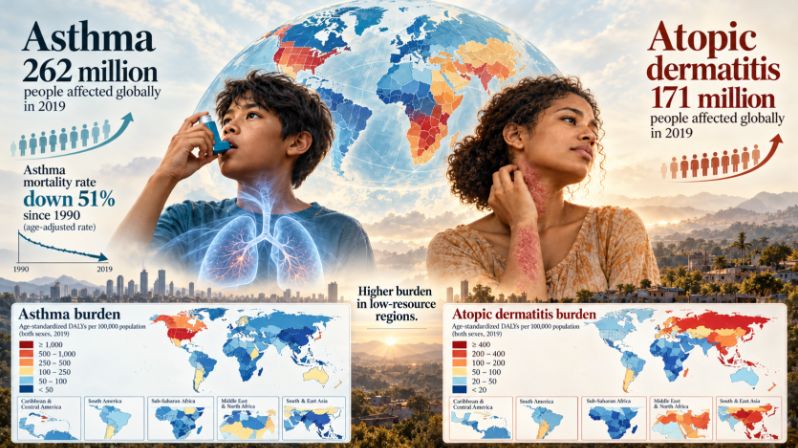
Over three decades, the global risk of asthma has declined, yet millions more people are living with asthma and eczema. A sweeping analysis of worldwide health data reveals why these seemingly contradictory trends can coexist and why the burden of allergic disease remains deeply unequal.
A Growing Burden Behind Declining Disease Rates
For a child with asthma, a nighttime cough can signal more than a restless night. It may be the beginning of an attack that requires urgent medical attention. For someone living with eczema, persistent itching and inflamed skin can disrupt sleep, interfere with work or school, and turn an ordinary day into a struggle for comfort. These experiences are familiar across the world, but their frequency and consequences vary considerably depending on where people live.
Over the past three decades, an unexpected pattern has emerged. Although asthma has become less common after adjusting for changes in population age, the number of people living with the disease has continued to rise. Eczema, meanwhile, has shown little improvement in its population-adjusted prevalence, even as its overall burden has expanded.
A study published in Allergy in 2023 examined the burden of asthma and atopic dermatitis, commonly known as eczema, across 204 countries and territories between 1990 and 2019. The researchers estimated that approximately 262 million people were living with asthma and 171 million with eczema in 2019, representing increases of 15.4% and 28.6%, respectively, since 1990.
Yet the age-standardized prevalence of asthma declined by 24.1% over the same period, while eczema prevalence decreased by just 4.3%. These rates account for differences in population age, allowing comparisons between populations that have grown and aged over time.
The apparent contradiction reflects an important distinction in public health. A disease can become less common within a standardized population while affecting more people overall, particularly as the world's population expands. The findings therefore raise a question that cannot be answered by counting cases alone: Are allergic diseases becoming easier to prevent and manage, or is their growing burden simply being reshaped by demographic and social changes?
Asthma Death Rates Have Declined, but the Disease Remains Dangerous
Among the more encouraging findings is the decline in asthma mortality. According to the analysis published in Allergy, the global age-standardized asthma death rate fell by approximately 51% between 1990 and 2019.¹ A separate study published in Frontiers in Public Health also documented declining asthma mortality, although its estimates differed somewhat because of analytical methods.
Despite this improvement, the total number of deaths remained remarkably stable. Approximately 460,000 people died from asthma in 1990, compared with about 461,000 in 2019. In other words, a lower population-adjusted risk of dying from asthma did not translate into a substantial reduction in the worldwide number of deaths.
Improvements in diagnosis, greater recognition of chronic airway inflammation, and the availability of effective inhaled medications may have contributed to the mortality decline. Tobacco control and changes in environmental or workplace exposures may also have played a role. However, the studies were not designed to determine how much of the improvement could be attributed to any particular intervention. Population aging, changes in disease classification, and differences in healthcare reporting further complicate the interpretation.
Another finding deserves attention. When researchers examined asthma patterns across birth generations, they observed that the modeled risk of developing asthma increased among more recent birth cohorts, even as overall incidence declined. Changing environments, lifestyles, and early-life exposures are possible explanations, but the data cannot establish that these factors caused the pattern. Because the analysis relied on population-level estimates rather than following individuals throughout their lives, the generational findings remain suggestive rather than conclusive.
What is clearer is that asthma has not ceased to be a serious disease. Its global mortality rate may have fallen, but hundreds of thousands of deaths continued to occur annually at the end of the study period.
Eczema Has Followed a Different Path
The story of eczema is less encouraging. Unlike asthma, which can cause fatal respiratory attacks, atopic dermatitis primarily imposes its burden through chronic symptoms and disability. Persistent itching, recurrent inflammation, disturbed sleep, and the emotional effects of visible skin disease can affect nearly every aspect of daily life.
Between 1990 and 2019, the estimated number of people living with eczema increased from 133 million to 171 million. Yet its age-adjusted prevalence declined by only 4.3%, considerably less than the reduction observed for asthma. The worldwide disability burden associated with eczema increased by approximately 28%, reaching 7.48 million disability-adjusted life years in 2019.
Disability-adjusted life years measure the years of healthy life lost because of illness, disability, or premature death. For eczema, this burden is overwhelmingly associated with living with the condition rather than dying from it. The absence of directly attributed eczema deaths in the global study's accounting system should not be mistaken for an absence of serious medical complications.
A systematic review published in Dermatology and Therapy further described the considerable effects of atopic dermatitis on sleep, emotional well-being, social relationships, and productivity. The disease may begin in infancy, but it does not necessarily disappear with age. Some patients experience persistent symptoms into adulthood, while others develop eczema later in life.
Although asthma and eczema share certain immune pathways and frequently coexist, they are not interchangeable manifestations of the same disease. Eczema involves disruption of the skin barrier and complex inflammatory responses, and elevated allergy antibodies are not present in every patient. Their different epidemiological trajectories suggest that improvements affecting one condition may not necessarily produce comparable benefits for the other.
Why Do Wealthier Countries Report More Allergic Disease?
One of the most intriguing findings concerns geography. Asthma and eczema were generally more prevalent in countries with higher levels of socioeconomic development, yet asthma-related deaths and disability were disproportionately concentrated in less developed regions.
In 2019, high-income North America had an estimated age-standardized asthma prevalence of approximately 9,848 cases per 100,000 people, compared with only 2,026 per 100,000 in East Asia. For eczema, particularly high prevalence rates were observed in high-income Asia Pacific and Central Asia, while lower rates were estimated in parts of sub-Saharan Africa.
These differences have prompted longstanding questions about how modern living environments influence allergic disease. Urbanization, indoor air pollution, tobacco smoke, changes in microbial exposure, housing conditions, and lifestyle factors have all been investigated as possible contributors. Yet no single explanation adequately accounts for the geographic distribution of asthma and eczema.
An equally important consideration is how diseases are identified. Wealthier countries generally have more extensive healthcare systems, greater access to diagnostic testing, and better-established disease surveillance. In settings where medical resources are limited, people with chronic coughing, wheezing, or skin inflammation may never receive a formal diagnosis. Some of the apparent differences between countries may therefore reflect how disease is measured rather than how frequently it truly occurs.
The pattern becomes more troubling when mortality is considered. Countries with lower socioeconomic development reported greater asthma-related death and disability rates despite having lower recorded asthma prevalence. In 2019, the least developed socioeconomic group experienced approximately 554 asthma-related disability-adjusted life years per 100,000 people, compared with roughly 158 in the high-middle development group.
Access to treatment is one likely contributor to this disparity. Inhaled corticosteroid-containing medications can reduce the risk of serious asthma attacks, but their availability, affordability, and consistent use remain uneven worldwide.
The contrast reveals a fundamental imbalance: Allergic diseases may be diagnosed more frequently in wealthier societies, but their most severe consequences are often borne by populations with fewer medical resources.
Allergic Diseases Do Not End with Childhood
Asthma and eczema are often portrayed as childhood conditions, but the global data suggest that their burden changes considerably across the lifespan. Both diseases showed high prevalence during early childhood, particularly between ages five and nine, followed by lower rates during young adulthood and a renewed increase in some older populations.
For asthma, a notable difference between males and females was observed. Boys generally experienced higher rates during childhood, but the pattern reversed after adolescence, when asthma became more prevalent among women. Hormonal influences, developmental changes in airway anatomy, and differences in environmental exposures have been investigated as possible explanations, although the relative contribution of each remains uncertain.
Older adults face a separate challenge. Although asthma can develop or persist at any age, the risk of asthma-related death rises substantially later in life. Reduced respiratory reserve, coexisting cardiovascular or pulmonary disease, and greater difficulty distinguishing asthma from other causes of breathlessness may complicate diagnosis and treatment.
Eczema also extends beyond childhood. Its symptoms may persist for decades, and in some populations the burden is greater among adult women than men. These patterns challenge the common assumption that allergic diseases can simply be outgrown and underscore the importance of recognizing chronic inflammation throughout adulthood.
The Role of Obesity, Smoking, and Environmental Exposures
The global analysis identified several potentially modifiable factors associated with asthma-related illness and death. Among the three major risks evaluated, elevated body mass index accounted for the largest estimated burden, approximately 3.65 million disability-adjusted life years and 75,000 asthma deaths in 2019. Smoking contributed an estimated 2.12 million disability-adjusted life years, while occupational exposure to asthma-inducing dusts, chemicals, and fumes accounted for approximately 1.90 million.
These figures represent statistical estimates of disease burden attributable to particular exposures, not proof that any single factor directly caused each illness or death. Asthma arises through interactions among genetic susceptibility, immune responses, airway physiology, and environmental conditions. Excess body weight may worsen respiratory mechanics and contribute to certain inflammatory processes, while tobacco smoke and workplace irritants can damage the airways or aggravate existing disease.
The findings nevertheless suggest that asthma prevention cannot be confined to the physician's office. Healthier living conditions, smoking prevention, occupational safety, and attention to metabolic health may complement medical treatment. Such measures are particularly relevant in regions where environmental exposures are substantial and access to chronic disease management is limited.
For eczema, comparable global estimates of attributable environmental risks were not available in the study. This absence of data should not be interpreted as evidence that environmental factors are unimportant. Rather, it illustrates how much remains uncertain about the influences shaping the worldwide burden of chronic inflammatory skin disease.
Are Allergic Diseases Really Becoming Less Common?
The two global studies provide valuable insights, but their conclusions require some caution. Much of the analysis depended on statistical modeling designed to reconcile incomplete and inconsistent health data across countries. Diagnostic definitions differed, medical records were not equally available, and symptom-based surveys could miss people whose asthma was well controlled with treatment. Conversely, some respiratory symptoms may have been incorrectly attributed to asthma.
These limitations are particularly important when comparing wealthy and lower-income countries. Where diagnosis is limited, recorded disease prevalence may underestimate the true burden. The studies also ended in 2019, so their results cannot establish whether the same trends continued during the subsequent years.
Still, a central message emerges. The worldwide burden of asthma and eczema cannot be understood through a single statistic. Asthma has shown meaningful declines in population-adjusted prevalence and mortality, while eczema has remained a persistent cause of disability. At the same time, growing populations have increased the absolute number of people affected by both conditions.
For public health, the next challenge is not simply to reduce the number of diagnosed cases. It is to make effective treatment and long-term disease control accessible to the people who need them. Asthma attacks may be prevented more effectively when airway inflammation is appropriately treated, while eczema requires sustained attention to skin inflammation, sleep disruption, and quality of life.
The global statistics contain evidence of progress, but they also reveal its limits. Fewer deaths per capita do not mean that asthma has become harmless, and a modest change in eczema prevalence does not diminish the suffering experienced by millions.
The most meaningful measure of progress may ultimately be not how many people are counted as having an allergic disease, but how many can live without being seriously limited by it.
Reference
1. Shin YH, Hwang J, Kwon R, et al. Global, regional, and national burden of allergic disorders and their risk factors in 204 countries and territories, from 1990 to 2019: a systematic analysis for the Global Burden of Disease Study 2019. Allergy. 2023;78(8):2232-2254. doi:10.1111/all.15807
2. Cao Y, Chen S, Chen X, et al. Global trends in the incidence and mortality of asthma from 1990 to 2019: an age-period-cohort analysis using the Global Burden of Disease Study 2019. Front Public Health. 2022;10:1036674. doi:10.3389/fpubh.2022.1036674
3. Fasseeh AN, Elezbawy B, Korra N, et al. Burden of atopic dermatitis in adults and adolescents: a systematic literature review. Dermatol Ther (Heidelb). 2022;12(12):2653-2668. doi:10.1007/s13555-022-00819-6
4. García-Marcos L, Chiang CY, Asher MI, et al. Asthma management and control in children, adolescents, and adults in 25 countries: a Global Asthma Network Phase I cross-sectional study. Lancet Glob Health. 2023;11(2):e218-e228. doi:10.1016/S2214-109X(22)00506-X
5. Levy ML, Bacharier LB, Bateman E, et al. Key recommendations for primary care from the 2022 Global Initiative for Asthma (GINA) update. NPJ Prim Care Respir Med. 2023;33(1):7. doi:10.1038/s41533-023-00330-1