

In Asthma, How You Feel May Not Reveal What Is Happening in Your Lungs
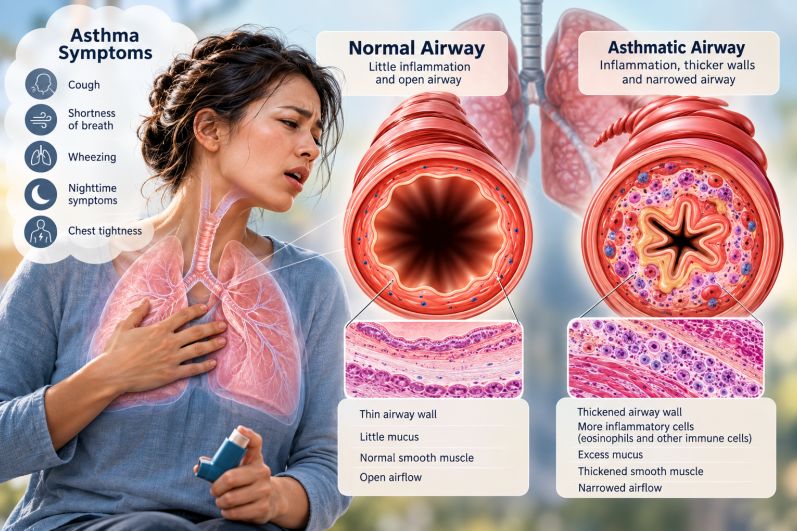
How badly someone feels may reveal surprisingly little about the inflammation inside their lungs, a finding that could change how asthma treatment is approached
For someone living with asthma, the signals seem straightforward. More wheezing, coughing or shortness of breath should mean the disease is getting worse. And if asthma feels worse, more anti-inflammatory treatment might seem like the logical response.
But asthma biology is not always so cooperative.
A large analysis published in The Lancet Respiratory Medicine suggests that the symptoms people experience can be surprisingly disconnected from the inflammation occurring in their airways. After examining data from 7,161 people with asthma, researchers found that symptom burden did not consistently correspond with lung function or with several important measures of airway inflammation.
That distinction has practical consequences. Symptoms remain essential for understanding how asthma affects a person's life, but they may be considerably less useful for answering another question: What is actually driving the disease, and which treatment is most likely to help?
When Symptoms and Inflammation Tell Different Stories
Asthma has traditionally been assessed partly by asking patients how often they wheeze, cough, awaken at night or struggle to breathe. These questions remain important because asthma is ultimately a disease experienced by a person, not simply a collection of laboratory values.
Yet the new analysis found little consistent relationship between symptom burden and several biological features of asthma. People reporting more symptoms did not necessarily have higher blood or airway eosinophils, higher fractional exhaled nitric oxide, or FeNO, or worse lung function.
The reverse problem can also occur. A person who feels reasonably well may still have underlying airway inflammation that increases the risk of future attacks.
This apparent contradiction makes more sense when asthma symptoms are considered in context. Breathlessness, for example, can be influenced by obesity, physical deconditioning, dysfunctional breathing and other conditions that may coexist with asthma. Two people describing similar shortness of breath may therefore have very different biological processes occurring in their lungs.
A symptom questionnaire can tell a clinician how someone feels. It cannot necessarily reveal why.
Feeling Worse Does Predict Risk, Just Not Very Well
Symptoms were not irrelevant to future asthma attacks. People with higher scores on the five-item Asthma Control Questionnaire, or ACQ-5, did experience somewhat more attacks later.
But the relationship was modest.
For every clinically meaningful 0.5-point increase in the symptom score, the adjusted rate of subsequent asthma attacks increased by about 9 percent. When symptom scores were added to a broader prediction model, they contributed relatively little additional information.
A history of previous asthma attacks provided a stronger warning signal.
That finding reflects an increasingly important distinction in asthma medicine: current symptoms and future risk are not the same thing. Someone can be uncomfortable today without being at especially high risk of a severe inflammatory attack, while another person with relatively mild day-to-day symptoms may have biological features that place them at substantial future risk.
The Clues Hidden in Blood and Breath
The contrast became particularly striking when researchers examined whether symptoms could predict who would benefit from anti-inflammatory treatment.
They could not do so reliably.
In data from the DREAM trial, patients received mepolizumab, a biologic medication that targets an inflammatory pathway involving interleukin-5 and eosinophils. If severe symptoms were a good proxy for this type of inflammation, the most symptomatic patients might have been expected to benefit most. Instead, symptom burden did not meaningfully distinguish who responded.
Two biological measurements did much better: blood eosinophils and FeNO.
Eosinophils are immune cells involved in a common form of airway inflammation. FeNO measures nitric oxide in exhaled breath and can provide another window into type 2 inflammation in the airways.
When both markers were elevated, the benefits of mepolizumab were particularly apparent. Among these patients, asthma attack rates were 2.81 with placebo and 1.17 with mepolizumab, corresponding to an adjusted rate ratio of 0.38. Among patients with low eosinophils and low FeNO, by contrast, the same treatment did not produce a clear reduction in attacks.
The implication is subtle but important. The severity of a symptom does not necessarily identify the biological pathway producing it.
Why This Matters for Steroids
The same question becomes especially important with corticosteroids.
Steroids can be lifesaving during serious asthma exacerbations and remain fundamental to asthma treatment. But systemic corticosteroids also carry substantial risks when repeatedly or unnecessarily used, including osteoporosis, diabetes, adrenal suppression and infections.
In two prospective cohorts included in the analysis, symptom severity during an asthma attack did not reliably predict how much lung function would improve after oral corticosteroid treatment. Measures of type 2 inflammation were more informative about treatment response.
This does not mean that people experiencing asthma attacks should wait for laboratory testing before following their prescribed emergency treatment plan. Acute asthma can deteriorate rapidly.
Instead, the findings raise a different question: Should long-term anti-inflammatory treatment be intensified simply because symptoms have increased?
For some patients, the answer may lie in inflammation. For others, persistent symptoms may have additional causes that require a different approach. Automatically equating symptoms with inflammation risks treating the sensation rather than identifying its source.
Asthma May Need Its Version of Cholesterol and Blood Pressure
Cardiovascular medicine offers a useful comparison.
Doctors do not determine someone's risk of a heart attack simply by asking whether the person has chest pain. Blood pressure, cholesterol, diabetes, smoking history and previous cardiovascular events are considered because dangerous disease can remain relatively quiet.
Asthma may increasingly be understood in much the same way.
Symptoms describe the burden of disease today. Previous attacks provide information about vulnerability. Spirometry measures airflow. Blood eosinophils and FeNO can reveal aspects of inflammatory activity. Each describes a different part of the disease.
None is sufficient alone.
This view also helps explain one of asthma's frustrating characteristics: two people who appear nearly identical in the examination room can respond very differently to the same medication. Their symptoms may sound alike while the biological machinery producing those symptoms is different.
Listening to Patients, and Looking Beyond Symptoms
The lesson from the new analysis is not that symptoms matter less. If anything, it clarifies what symptoms are best used for. They tell us how asthma affects someone's life. They warn that something has changed. And they should prompt clinicians to investigate why.
But symptoms alone may not reveal whether airway inflammation has intensified, whether a particular biologic therapy will work or whether more corticosteroid treatment is the appropriate response.
That makes the future of asthma care less about choosing between the patient's experience and laboratory measurements, and more about bringing the two together.
For decades, asthma care has understandably begun with a simple question: How are you breathing?
The emerging evidence suggests that another question should often follow:
What is happening inside your airways?
Reference
1. Couillard S, Meulmeester FL, Charland P, et al; Oxford Asthma Attack Risk Scale Meta-analysis (ORACLE2) Consortium. Symptom burden to characterise, predict, and prevent asthma attacks: a patient-level meta-analysis of randomised trials and translational prospective studies. Lancet Respir Med. Published online August 20, 2026. doi:10.1016/S2213-2600(26)00150-5.
2. Pavord ID, Korn S, Howarth P, et al. Mepolizumab for severe eosinophilic asthma (DREAM): a multicentre, double-blind, placebo-controlled trial. Lancet. 2012;380(9842):651-659. doi:10.1016/S0140-6736(12)60988-X.
3. Global Initiative for Asthma. Global Strategy for Asthma Management and Prevention. Global Initiative for Asthma.
4. Price DB, Trudo F, Voorham J, et al. Adverse outcomes from initiation of systemic corticosteroids for asthma: long-term observational study. J Asthma Allergy. 2018;11:193-204. doi:10.2147/JAA.S176026.
5. Busse WW, Kraft M, Rabe KF, et al. Understanding the key issues in the treatment of uncontrolled persistent asthma with type 2 inflammation. Eur Respir J. 2021;58(2):2003393. doi:10.1183/13993003.03393-2020.