

How Allergy Became a Disease of the Modern World
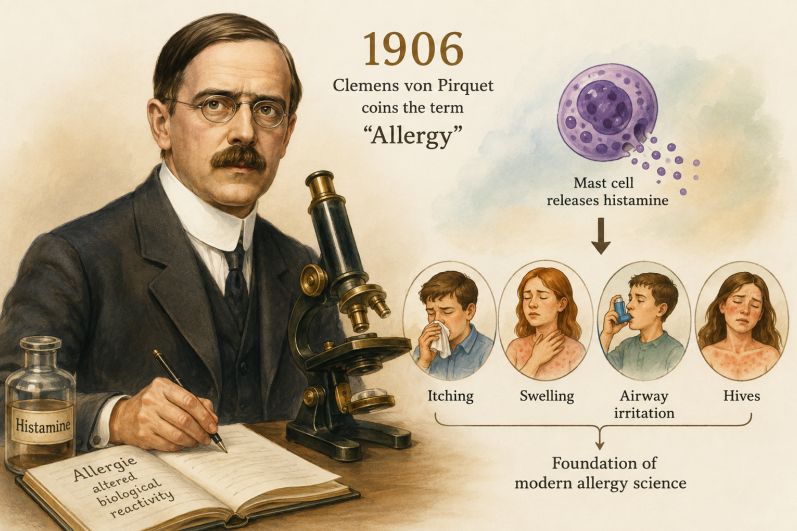
Just over a century ago, “allergy” did not exist as a medical diagnosis. Its rise reveals how changing environments, new ideas about immunity and an expanding medical marketplace transformed an obscure biological reaction into one of the defining health problems of modern life.
A Pediatrician Invents a New Word
In 1906 Austrian pediatrician Clemens von Pirquet proposed a term for an unusual phenomenon he had been observing: Allergie, derived from Greek roots suggesting an “altered reaction.”
Von Pirquet's original idea was broader than our modern definition. He was trying to describe how previous exposure to a substance could change the way an organism responded when it encountered that substance again.
Sometimes the change was protective. Sometimes it produced disease.This was an important conceptual leap. Instead of asking only, What is this foreign substance doing to the body?, physicians increasingly had to ask another question:
What is the body doing in response?
That distinction became fundamental to immunology. Around the same period, researchers studying anaphylaxis encountered an especially dramatic example of the paradox. Exposure to a foreign protein did not necessarily protect an experimental animal against a subsequent exposure. Under certain circumstances, it could make the next exposure catastrophically dangerous.
The immune system, it seemed, could be both defender and source of injury.
Allergy Finds Its Place in Immunology
For decades, the boundaries between allergy, anaphylaxis and immunity remained unsettled. Competing terminology reflected competing theories about what these reactions actually represented.
Gradually, however, allergy became integrated into the emerging science of immunology. An important step came in 1963, when British immunologists Philip Gell and Robin Coombs introduced a classification of hypersensitivity reactions according to the immune mechanisms producing them. Their framework helped transform a collection of seemingly unrelated clinical observations into recognizable patterns of immune-mediated disease.
Later discoveries supplied much of the molecular machinery.
Immunoglobulin E, or IgE, was identified as a key antibody involved in many immediate allergic reactions. Mast cells were shown to release histamine and other inflammatory substances. Eosinophils emerged as important participants in many allergic disorders. More recently, epithelial cells lining the skin, lungs and gastrointestinal tract have increasingly been recognized as active participants in immune signaling rather than simply passive walls separating the body from the environment.
A condition once described mainly by sneezing, wheezing and rashes could increasingly be explained through cells, antibodies, receptors and chemical signals.
Yet an even larger mystery was developing outside the laboratory. Allergy appeared to be becoming much more common.
From a “Fashionable” Illness to a Population Problem
Allergy was not always perceived as the widespread health problem it is today. At various points in its history, allergic illness could be portrayed as a fashionable complaint associated with wealthier people and modern lifestyles.
That characterization became progressively harder to defend.
Asthma, allergic rhinitis, eczema and food allergy became increasingly visible across industrialized societies. Allergic disease began affecting schools, workplaces and healthcare systems, not merely a small collection of unusually sensitive individuals.
The transformation raised a difficult question that remains unresolved: Why should modernization be accompanied by so much allergic disease?
Human genes cannot change dramatically across an entire population in only a few generations. Something about the environments in which those genes operate must also matter.
A wide range of possibilities has consequently been investigated, including declining exposure to certain microorganisms, antibiotic use, changes in childhood infections, air pollution, indoor lifestyles, altered diets, reduced biodiversity, changes in the intestinal microbiome and disruption of the epithelial barriers lining the skin, lungs and gut.
No single explanation has accounted for the entire phenomenon. Instead, modern allergy is increasingly viewed as the product of interactions among genetic susceptibility, immune development and environmental exposure.
The history of allergy therefore contains an intriguing reversal. The field began by asking why particular people reacted abnormally to ordinary substances. A century later, another question had become unavoidable: What changed in ordinary life that made these abnormal reactions so common?
The Battle over How to Treat Allergy
As physicians became better at recognizing allergy, disagreement developed over what should be done about it. One strategy attempted to retrain the immune response itself. Small, controlled quantities of an allergen could be repeatedly administered in an effort to make the patient less sensitive. The approach became known as desensitization and later as allergen immunotherapy.
Another strategy was emerging from pharmacology. If allergic symptoms resulted partly from histamine and other inflammatory mediators, perhaps those signals could simply be blocked. The arrival of antihistamine drugs offered a relatively straightforward way to suppress symptoms without deliberately exposing patients to the offending allergen.
These approaches represented two different philosophies that remain recognizable in medicine today: modify the disease or control its consequences.
Early allergen immunotherapy also carried genuine risks. Severe systemic reactions, including fatalities, contributed to periods of declining enthusiasm for the treatment in Britain. Over time, increasingly rigorous dosing protocols, patient selection and emergency precautions were developed.
Modern allergy practice has expanded far beyond this early choice. Inhaled corticosteroids can suppress airway inflammation. Epinephrine can reverse life-threatening anaphylaxis. Allergen immunotherapy can induce longer-lasting changes in allergen responsiveness. And biologic medicines can now selectively interfere with immune pathways involving IgE, interleukins and other components of type 2 inflammation.
The therapeutic toolbox has become remarkably sophisticated. So has the marketplace surrounding it.
When Allergy Became an Industry
Once allergic disease became common, it inevitably acquired an economy. Pharmaceutical companies developed antihistamines, nasal sprays, asthma inhalers, epinephrine devices and, eventually, highly targeted biologic drugs. Diagnostic testing expanded. Immunotherapy became standardized. Entire medical specialties and research programs developed around allergic and immunologic disease.
Outside medicine, another marketplace appeared. Consumers encountered allergen-proof bedding, specialized vacuum cleaners, air filtration systems, cleaning products and numerous products promising healthier indoor environments.
Some interventions have strong evidence behind them. Others have much less. The distinction matters because the commercial history of allergy illustrates something larger about modern medicine: when millions of people share a chronic condition, that condition does not remain solely a biological phenomenon. It becomes an economic one as well.
Disease creates markets, and markets can influence how disease is perceived. This does not mean that the rise in allergic illness was manufactured by industry. The health burden is substantial and measurable. But the history described by medical historian Mark Jackson and reviewed by John Henderson in the BMJ shows how scientific discovery, changing patterns of illness and commercial interests can evolve together.
The Hidden Cost of Sneezing and Wheezing
The economic consequences of allergy also extend far beyond the pharmacy counter. Consider allergic rhinitis. It rarely sends someone to an intensive care unit, yet persistent congestion can interfere with sleep, concentration and work. A child with poorly controlled asthma may miss school repeatedly. A parent may then miss work to care for that child. Severe food allergy can influence where families eat, travel and attend school.
These effects accumulate. A disease does not need to be fatal to impose a substantial burden on society. Chronic conditions can extract their cost through lost productivity, disrupted education, medical visits and diminished quality of life.
That realization helped change allergy's cultural status. What could once be dismissed as an inconvenience increasingly became recognized as an important public health problem.
The Mystery Has Shifted
Von Pirquet could not have imagined the molecular vocabulary used to describe allergy today. IgE, cytokines, epithelial alarmins, mast-cell receptors and targeted biologic therapies belonged to a scientific future that was still decades away. Yet the question that motivated the concept of allergy remains remarkably recognizable.
Why does one person's immune system tolerate something that another person's attacks?
Modern science has begun to answer that question at the molecular level. But the extraordinary prevalence of allergic disease has created a second question that may be even harder: Why are so many immune systems making that mistake now?
The answer is unlikely to reside in pollen, peanuts, dust mites or pets alone. Humans have encountered many potential allergens for far longer than the modern allergy epidemic has existed.
Attention has therefore increasingly shifted toward the biological context in which those exposures occur: the integrity of epithelial barriers, microbial communities inhabiting the body, pollutants in the air, patterns of infection and antibiotic exposure, diet, housing and the timing of environmental encounters during early immune development.
These ideas remain under investigation, and history offers good reason for caution. Allergy has repeatedly been reshaped by new theories, technologies and commercial interests. Today's most compelling explanation may eventually prove to be only one part of a much larger biological story.
A Modern Disease with an Old Biological Question
There is something paradoxical about the history of allergy. The substances blamed for allergic disease are often ancient. Flowering plants have produced pollen for millions of years. Humans have lived alongside animals throughout civilization. Foods capable of becoming allergens existed long before allergy clinics.
What changed most dramatically was not necessarily the allergens. It was us, and the environments we created around ourselves.
During the century since von Pirquet gave allergy its name, humans have transformed housing, sanitation, food production, medicine, transportation, air quality and our relationships with microorganisms. At the same time, the science of immunity has revealed that the body's defenses are extraordinarily dependent on context.
An immune system must perform a delicate calculation throughout life. It must attack pathogens while tolerating food, environmental particles, resident microbes and the body's own tissues. Too little response leaves us vulnerable to infection. Too much response can produce inflammation and disease.
Allergy occupies one side of that biological balancing act. More than 100 years after physicians first gave it a name, the science has become vastly more sophisticated. But the underlying mystery has endured.
The modern history of allergy began with the discovery that disease can arise not simply from something dangerous entering the body, but from the body deciding that something harmless is dangerous.
Understanding why that decision has become so common may be one of the most important chapters still waiting to be written.
Reference
1. Henderson J. Allergy: The History of a Modern Malady. BMJ. 2006;333(7569):659.
2. Jackson M. Allergy: The History of a Modern Malady. London, England: Reaktion Books; 2006.
3. Kruszewski J. W stulecie publikacji Clemensa von Pirqueta: "Allergie" Muenchener medizinische Wochenschrift; 53, 1457-1458 [On the 100th anniversary of Clemens von Pirquet "Allergie", Muenchener medizinische Wochenschrift; 53, 1457-1458]. Pol Merkur Lekarski. 2006;20(119):501-504.
4. Gell PGH, Coombs RRA, eds. Clinical Aspects of Immunology. Oxford, England: Blackwell Scientific Publications; 1963.
5. Kumar R. History of allergy. Indian J Med Res. 2016;143(3):386-387. doi:10.4103/0971-5916.182640