

Can Asthma Damage Be Reversed? A New Era of Treatment Is Challenging Old Assumptions
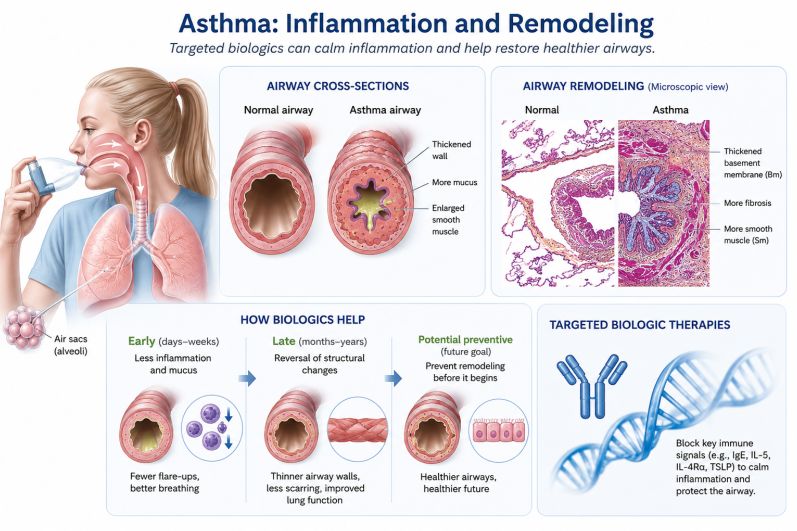
For generations, asthma has been understood primarily as a disease of inflammation. During an asthma attack, immune cells flood the airways, muscles tighten, mucus accumulates, and breathing becomes difficult. But beneath these familiar symptoms, a quieter process has long been unfolding. Over years of chronic inflammation, the airways themselves can be reshaped. Their walls thicken, smooth muscle expands, scar-like tissue accumulates, and mucus-producing cells multiply. This process, known as airway remodeling, has traditionally been viewed as a one-way path toward permanent lung damage.
From Inflamed Airways to Changing Architecture
Asthma has traditionally been described as a disorder of immune overreaction. Allergens, viruses, pollutants, or other irritants trigger an exaggerated inflammatory response, leading to coughing, wheezing, and shortness of breath. Standard treatments, particularly inhaled corticosteroids, have been highly successful at reducing this inflammation and preventing asthma attacks.
Yet many patients continue to lose lung function over time despite receiving appropriate therapy.
The reason appears to lie in structural changes that occur alongside inflammation. Repeated injury and repair gradually remodel the airways. The lining of the airway becomes damaged, mucus-producing goblet cells become more abundant, the basement membrane beneath the lining thickens, smooth muscle surrounding the airway enlarges, and excess collagen is deposited, creating scar-like tissue. Small airways become narrowed and less flexible, making airflow increasingly difficult.
For many years, these changes were thought to explain why some people develop fixed airflow obstruction, a condition in which breathing remains impaired even after bronchodilators or corticosteroids are administered. Because these patients often showed little improvement with conventional therapies, the obstruction was widely considered permanent.
That interpretation is now being reconsidered.
Biologics Are Revealing a More Dynamic Disease
Biologic therapies were initially developed to control severe asthma by targeting specific immune pathways rather than suppressing the immune system broadly.
Different biologics interrupt different signals. Some block immunoglobulin E (IgE), the antibody responsible for allergic reactions. Others inhibit eosinophils by targeting interleukin-5 (IL-5), while newer therapies block interleukin-4 and interleukin-13 signaling or upstream "alarmin" molecules such as thymic stromal lymphopoietin (TSLP), which help initiate airway inflammation.
What has surprised researchers is that the benefits appear to extend well beyond symptom relief.
Over months and years of treatment, reductions have been observed not only in asthma attacks but also in airway wall thickness, smooth muscle mass, mucus plugging, and fibrotic tissue beneath the airway lining. In some patients whose lung function had previously been considered permanently impaired, breathing tests have improved dramatically, occasionally returning to nearly normal values.
These observations suggest that at least some forms of fixed airflow obstruction may reflect active biological processes rather than irreversible scarring alone.
The implications are significant. If airway remodeling can be modified, asthma may become a disease whose long-term trajectory can be altered rather than simply managed.
The First Improvements May Appear Surprisingly Quickly
Although reversing structural changes takes time, biologics often begin producing measurable benefits within weeks.
Patients commonly experience fewer exacerbations, less coughing, and improved breathing shortly after treatment begins. Lung function frequently improves within the first month, particularly with therapies targeting IL-4 receptor alpha or TSLP.
Advanced imaging has revealed another striking effect: mucus plugs that obstruct the smallest airways may begin to disappear early during treatment. These plugs, once considered a hallmark of severe asthma, are increasingly recognized as an important contributor to airflow limitation.
Some of the earliest improvements are detectable in the smallest airways, regions that contribute relatively little to conventional spirometry measurements but account for most of the lung's total airway surface area. New physiological tests and imaging techniques are demonstrating that these peripheral airways often improve before traditional lung function tests fully reflect the change.
The Airway Epithelium Is Emerging as the Master Regulator
Perhaps the most important conceptual shift in asthma research is the growing recognition that the airway epithelium is far more than a protective lining.
The epithelium forms the body's first point of contact with the outside environment. Every breath exposes these cells to pollen, dust mites, respiratory viruses, pollution, smoke, and countless other airborne particles.
When healthy, the epithelial barrier carefully regulates what enters the underlying tissues. But when injured, epithelial cells release powerful signaling molecules known as alarmins, including TSLP, IL-33, and IL-25. These molecules activate immune cells throughout the airway, amplify allergic inflammation, stimulate mucus production, recruit eosinophils, and promote many of the structural changes associated with airway remodeling.
Rather than viewing asthma solely as a disorder of immune cells, researchers increasingly see it as a disease initiated by a dysfunctional epithelial barrier that continually alerts the immune system to perceived danger.
This perspective represents a major shift in thinking. Instead of focusing exclusively on suppressing inflammation after it develops, future therapies may seek to restore the integrity of the epithelial barrier itself, preventing excessive immune activation before it begins.
Beyond the Era of Big Data
During the past two decades, asthma research has embraced large-scale "omics" technologies that catalog genes, proteins, metabolites, and other molecular signatures in remarkable detail.
While these approaches have greatly expanded scientific knowledge, they have not always translated into equally dramatic improvements in patient care.
Some researchers now argue that the next major advances may come not from collecting ever-larger datasets but from understanding the biology of a single tissue: the airway epithelium.
This more focused strategy recognizes that many of the complex molecular signals identified through omics ultimately converge on a relatively small number of biological processes, particularly those governing epithelial barrier function, tissue repair, and communication with the immune system.
The goal is becoming less about identifying every molecular change and more about understanding which changes actually drive disease.
Can Asthma Be Prevented Before Damage Occurs?
One of the most provocative questions now facing asthma researchers is whether biologics should eventually be used earlier in the disease.
Current treatment guidelines reserve these medications primarily for patients whose asthma remains poorly controlled despite high-dose inhaled therapies. Yet airway remodeling may begin years before severe symptoms appear, and structural abnormalities have even been identified in young children.
If these changes prove to be reversible only during certain stages of disease, early intervention could become increasingly important.
This possibility remains hypothetical. Large clinical trials are still needed to determine whether earlier biologic treatment can safely prevent long-term structural damage, particularly in children. Questions also remain about which patients would benefit most and which biomarkers can identify those at greatest risk of progressive remodeling.
For now, biologics remain an important option for carefully selected patients with moderate-to-severe asthma, rather than a treatment for everyone with the disease.
Seeing Asthma in New Ways
Our ability to study asthma is also evolving. Traditional spirometry provides valuable information about overall lung function but offers only a limited view of what is happening inside individual airways.
New imaging methods, including high-resolution computed tomography, magnetic resonance imaging, and Functional Respiratory Imaging, are allowing investigators to visualize mucus plugs, airway narrowing, air trapping, and structural remodeling throughout the lungs. These technologies are beginning to reveal asthma as a disease that affects the entire bronchial tree, including countless small airways that were previously difficult to evaluate.
As imaging becomes more sophisticated, physicians may be able to monitor how structural changes respond to therapy, much as cardiologists monitor heart muscle or oncologists follow tumor response.
A Changing View of Asthma
The emerging picture of asthma is more nuanced than the traditional view of a disease driven solely by inflammation. It is increasingly understood as a disorder in which chronic immune activation, epithelial dysfunction, and structural remodeling interact continuously over many years.
Biologic therapies have demonstrated that this process is not necessarily fixed. Improvements in mucus plugging, airway wall thickening, fibrosis, and airflow have been documented in many patients receiving targeted treatment, suggesting that at least part of airway remodeling remains biologically active and potentially modifiable.
At the same time, attention is shifting toward the airway epithelium as the central regulator of the disease. If future therapies can preserve or restore this protective barrier before chronic remodeling becomes established, asthma management may evolve beyond controlling symptoms toward preventing long-term lung damage altogether.
That possibility remains under investigation. Yet it represents one of the most promising shifts in asthma research in decades, offering hope that the future of asthma care may focus not only on helping patients breathe better today, but also on preserving healthier lungs for years to come.
Reference
1. Picado C, Garcia de la Fuente A, Arismendi E, Roca-Ferrer J. Next Decade Research in Asthma: Broad Omics-Based Exploration Versus Targeted Airway Epithelium Studies. J Clin Med. 2025;14(22):8186. Published 2025 Nov 18. doi:10.3390/jcm14228186
2. Varricchi G, Poto R, Lommatzsch M, et al. Biologics and airway remodeling in asthma: early, late, and potential preventive effects. Allergy. 2025;80(2):408-422. doi:10.1111/all.16382
3. Akdis CA. Does the epithelial barrier hypothesis explain the increase in allergy, autoimmunity and other chronic conditions? Nat Rev Immunol. 2021;21(11):739-751. doi:10.1038/s41577-021-00538-7
4. Holgate ST. The sentinel role of the airway epithelium in asthma pathogenesis. Immunol Rev. 2011;242(1):205-219. doi:10.1111/j.1600-065X.2011.01030.x
5. Rabe KF, Calhoun WJ, Smith N, Jimenez P. Can anti-IgE therapy prevent airway remodeling in allergic asthma?. Allergy. 2011;66(9):1142-1151. doi:10.1111/j.1398-9995.2011.02617.x