

America’s Quiet Pollen Experiment
What the U.S. Should Learn from Japan’s Cedar Allergy Crisis
Every spring, millions of Americans experience the familiar rituals of allergy season: yellow pollen coating cars, antihistamine commercials dominating television, and crowded pharmacy aisles filled with nasal sprays and eye drops. Seasonal allergies have become so common that they are often treated as a minor inconvenience of modern life.
But across the Pacific, in Japan, scientists and public health officials are confronting a more sobering reality. There, nearly 40 percent of the population suffers from cedar and cypress pollinosis, a massive allergy epidemic created largely by postwar environmental engineering.
What makes Japan’s story especially important for Americans is that the United States may be conducting its own quieter version of the same experiment.
Not through vast cedar plantations alone, but through suburban expansion, urban landscaping, deforestation, monoculture development, and a little-known phenomenon called “botanical sexism.”
The Allergy Forests We Built Ourselves
Japan’s crisis began after World War II, when the government replanted mountainsides with enormous numbers of cedar and cypress trees to stabilize soil and support future timber production. Decades later, those forests matured simultaneously and began releasing extraordinary amounts of pollen into the atmosphere. The United States followed a different path, but one that may lead toward similar biological consequences.
As American suburbs expanded during the second half of the twentieth century, natural ecosystems were frequently cleared and replaced with carefully managed urban landscapes. Developers favored fast-growing ornamental trees that looked attractive, required little maintenance, and created uniform neighborhoods.
Increasingly, cities and landscapers selected male trees. Female trees drop fruit, seeds, and pods that clutter sidewalks and parking lots. Male trees, by contrast, were considered “clean.” But male trees release pollen—the microscopic reproductive particles that trigger allergic disease.
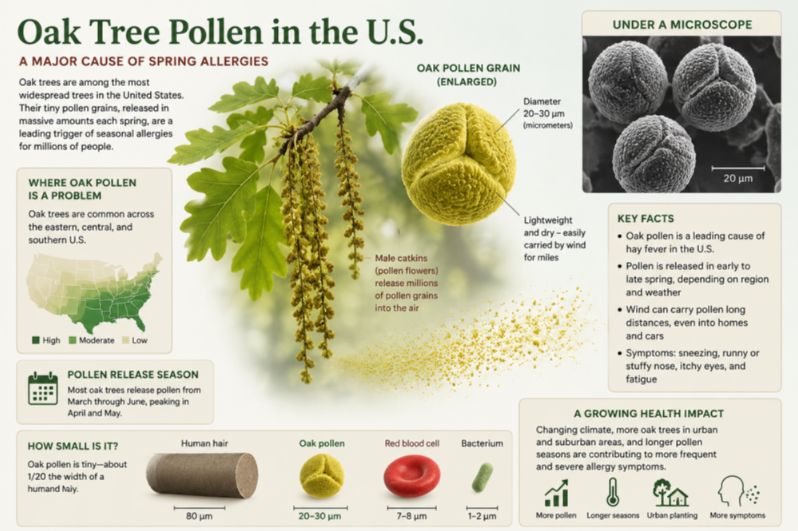
The result was an unintended shift in the biology of many American cities. Urban and suburban neighborhoods became increasingly dominated by pollen-producing landscapes. In places like Texas, where oak, juniper, ash, elm, pecan, and mountain cedar already produce large pollen burdens, new developments often intensified exposure by concentrating high-pollen species around homes, schools, and commercial centers.
Unlike Japan’s national cedar monoculture, the American version is fragmented and regional. But the principle is remarkably similar: human-designed landscapes altering population-wide immune exposure.
The Problem with Ecological Simplification
Natural forests are biologically messy. They contain diverse species blooming at different times and competing within complex ecosystems. Diversity tends to diffuse pollen exposure. Modern suburban landscapes often do the opposite. A housing development may replace hundreds of acres of mixed vegetation with rows of genetically similar ornamental trees chosen for symmetry, rapid growth, or drought resistance. Instead of ecological complexity, these environments create concentrated pollen corridors.
In effect, some American suburbs function almost like engineered pollen amplification systems. Researchers increasingly suspect that biodiversity loss itself may also influence immune health. Exposure to diverse environmental microbes and plant ecosystems appears important for healthy immune development, especially during childhood. Simplified urban ecosystems may therefore contribute not only to higher pollen counts, but also to altered immune regulation.
The immune system evolved in biologically rich environments. Modern urban landscapes are often biologically narrow but chemically and particulate-heavy.
Climate Change Is Supercharging Pollen Seasons
The parallel with Japan becomes even stronger when climate change enters the equation. Across North America, pollen seasons are becoming longer and more intense. Warmer temperatures lengthen growing seasons, while elevated atmospheric carbon dioxide can stimulate plants to produce more pollen. Urban heat islands, cities warmed by asphalt, concrete, and reduced vegetation diversity, further amplify the effect.
Some studies now show that pollen seasons in parts of the United States start earlier and last weeks longer than they did decades ago. For allergy sufferers, this means exposure is no longer confined to a brief spring nuisance. In some regions, overlapping tree, grass, and weed pollen seasons can create nearly continuous airway inflammation for much of the year. This may help explain why allergic disease and asthma have risen so dramatically over recent decades.
The Airways Are Not Separate from the Rest of the Body
For years, allergies were often viewed narrowly as disorders of the nose and eyes. But researchers increasingly recognize that chronic airway inflammation can affect sleep, cognition, mood, fatigue, exercise tolerance, and broader immune function.
Persistent inflammation in the respiratory tract may also influence systemic inflammatory pathways throughout the body. Pollen exposure rarely occurs in isolation. Urban air pollution particles can bind to pollen fragments, damage airway barriers, and intensify allergic sensitization. Wildfire smoke, ozone, diesel exhaust, and particulate matter may all interact with pollen exposure in ways that amplify respiratory disease.
In this sense, modern allergy epidemics may represent not merely a problem of “bad pollen,” but a collision between immune biology and engineered environments.
What America Should Learn from Japan
Japan’s experience offers the United States a glimpse into what happens when environmental planning fails to account for long-term biological consequences. The first lesson is that urban planning is also public health policy. Trees are not neutral infrastructure. The species selected for streets, schools, parks, and subdivisions shape the respiratory environment for generations. A city planted heavily with male high-pollen trees may unintentionally increase disease burden across an entire population.
Second, biodiversity matters. Monocultures, whether vast cedar forests in Japan or repetitive ornamental landscaping in American suburbs, create ecological vulnerability. Diverse ecosystems tend to distribute biological exposure more evenly and may support healthier environmental microbial networks.
Third, climate change transforms manageable environmental exposures into amplifying feedback loops. Longer growing seasons and rising pollen counts may turn existing allergy problems into much larger public health burdens over coming decades.
And finally, allergy disease should not be dismissed as trivial.
When millions of people experience chronic airway inflammation simultaneously, the consequences extend beyond sneezing. Sleep disruption, reduced concentration, asthma exacerbations, lost productivity, and impaired quality of life ripple across schools, workplaces, and healthcare systems.
Japan is now spending decades attempting to undo the unintended consequences of postwar forestry policy through logging programs, low-pollen tree replacement, and ecosystem restoration. The United States still has time to learn from that experience before its own urban pollen experiment grows even larger. Because once trees mature, environmental decisions can linger in the air for generations.
Reference
1. Tom Ogren Ogren TL. Allergy-Free Gardening: The Revolutionary Guide to Healthy Landscaping. Berkeley, CA: Ten Speed Press; 2000.
2. Anderegg WRL, Abatzoglou JT, Anderegg LDL, Bielory L, Kinney PL, Ziska L. Anthropogenic climate change is worsening North American pollen seasons. Proc Natl Acad Sci U S A. 2021;118(7):e2013284118. doi:10.1073/pnas.2013284118
3. D'Amato G, Cecchi L, D'Amato M, Annesi-Maesano I. Climate change and respiratory diseases. Eur Respir Rev. 2014;23(132):161-169. doi:10.1183/09059180.00001714
4. Haahtela T, Holgate S, Pawankar R, et al. The biodiversity hypothesis and allergic disease: world allergy organization position statement. World Allergy Organ J. 2013;6(1):3. Published 2013 Jan 31. doi:10.1186/1939-4551-6-3
5. Osada T, Okano M. Japanese cedar and cypress pollinosis updated: New allergens, cross-reactivity, and treatment. Allergol Int. 2021;70(3):281-290. doi:10.1016/j.alit.2021.04.002