

Why Women Are More Vulnerable to Autoimmune Disease
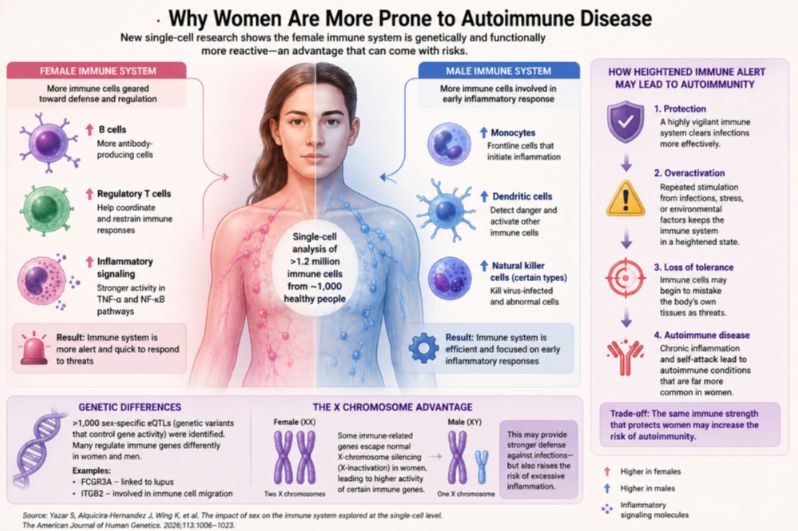
New single-cell research suggests the female immune system may be biologically wired for heightened vigilance, and that protective advantage may also carry hidden risks
For decades, physicians have recognized a striking pattern in medicine: women develop autoimmune diseases far more often than men.
Lupus affects women at rates approaching nine to one. Sjögren syndrome, Hashimoto thyroiditis, rheumatoid arthritis, and multiple sclerosis also show strong female predominance. Yet despite years of research, scientists have struggled to fully explain why the immune system turns against the body more frequently in women.
Now, a study published in The American Journal of Human Genetics is offering one of the clearest explanations yet. Using advanced single-cell sequencing technology, researchers analyzed more than 1.2 million immune cells from nearly 1,000 healthy individuals. Rather than studying blood as a blended mixture, scientists examined immune cells one by one, revealing profound biological differences between male and female immune systems.
An Immune System Tuned for Faster Response
The study found that women naturally possess a more immunologically reactive profile. Female participants had higher levels of B cells, the antibody-producing cells that help recognize and neutralize threats. Their immune cells also showed stronger activation of inflammatory pathways involving TNF-α and NF-κB signaling, molecular systems central to rapid immune defense. In many ways, the female immune system appears biologically designed to respond quickly and aggressively to danger.
That heightened vigilance may have evolved as a survival advantage. Throughout human history, infections during pregnancy and childbirth posed major threats to both mothers and infants. A stronger immune response may have improved survival across generations. But evolution often involves tradeoffs.
When Protection Becomes Overreaction
The immune system operates through constant judgment calls. Every day it must decide whether a signal represents a dangerous infection, harmless environmental exposure, or part of the body itself. A highly vigilant immune system may detect threats more efficiently. But it may also become more prone to false alarms.
The new findings suggest that women may begin with an immune system already operating closer to an inflammatory threshold. Over time, repeated immune activation, from infections, environmental exposures, stress, or chronic inflammation, could gradually increase the risk of losing immune tolerance.
Once that balance is disrupted, the immune system may begin attacking healthy tissues instead of protecting them. In this view, autoimmune disease may not arise from a weak immune system, but from one that is exceptionally active and sensitive.
The Genetic Differences Run Deep
The researchers also discovered that immune regulation differs genetically between men and women. The study identified more than 1,000 sex-specific genetic variants known as eQTLs, which influence how strongly immune genes are turned on or off depending on biological sex.
Several of these genes were already linked to autoimmune disease. Genes such as FCGR3A and ITGB2, both associated with lupus and inflammatory disorders, showed female-biased immune regulation. These findings suggest that the female immune system is not simply reacting differently because of hormones. Its underlying genetic circuitry itself appears differently tuned.
The X Chromosome Effect
Part of this difference may originate from the X chromosome. Women carry two X chromosomes, while men carry one X and one Y chromosome. Although one female X chromosome is mostly silenced, some immune-related genes partially escape that shutdown.
The study found that several of these escape genes showed stronger activity in women. This may provide women with a more robust immune defense against infections, but potentially at the cost of increased inflammatory activity and higher autoimmune risk.
A New Understanding of Autoimmune Disease
Importantly, the researchers studied healthy individuals at baseline, meaning these immune differences exist even before illness develops. During infections, chronic stress, pollution exposure, or ongoing inflammation, the biological gap between male and female immunity may widen further.
The findings are helping reshape how scientists think about autoimmune disease itself. Rather than viewing autoimmunity simply as a malfunction, researchers increasingly suspect it may represent the unintended consequence of an immune system evolved for extraordinary vigilance.
The same biological strengths that help protect against infection may, under certain conditions, become the very forces that drive chronic inflammation and self-attack. In other words, the female immune system’s greatest evolutionary advantage may also help explain its greatest vulnerability.
Reference
1. Yazar S, Alquicira-Hernandez J, Wing K, et al. The impact of sex on the immune system explored at the single-cell level. The American Journal of Human Genetics. 2026;113:1006-1023.
2. Klein SL, Flanagan KL. Sex differences in immune responses. Nat Rev Immunol. 2016;16(10):626-638. doi:10.1038/nri.2016.90
3. Whitacre CC. Sex differences in autoimmune disease. Nat Immunol. 2001;2(9):777-780. doi:10.1038/ni0901-777
4. Libert C, Dejager L, Pinheiro I. The X chromosome in immune functions: when a chromosome makes the difference. Nat Rev Immunol. 2010;10(8):594-604. doi:10.1038/nri2815
5. Takahashi T, Ellingson MK, Wong P, et al. Sex differences in immune responses that underlie COVID-19 disease outcomes. Nature. 2020;588(7837):315-320. doi:10.1038/s41586-020-2700-3