

Japan’s Hay Fever Crisis: How a Postwar Reforestation Plan Triggered a National Allergy Epidemic
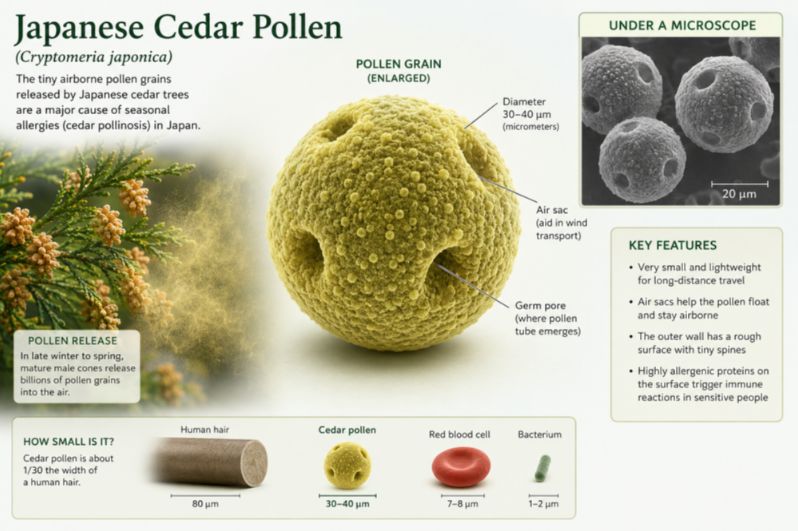
Every spring, millions of people in Japan brace themselves for what many describe as a seasonal assault. Drugstores fill with masks and antihistamines. Trains carry commuters rubbing swollen eyes. Schools and workplaces see declines in concentration and productivity. What began as an environmental recovery effort after World War II has evolved into one of the world’s most remarkable public health stories: a man-made pollen epidemic.
The roots of this crisis stretch back more than half a century.
A Well-Intentioned Mistake
In the aftermath of the war, Japan faced a devastated landscape. Large areas of forest had been stripped for fuel and construction materials. Mountainsides became vulnerable to erosion and landslides. Rebuilding the nation required timber, and fast.
The government responded with a sweeping reforestation campaign during the 1950s and 1960s. Millions of cedar and cypress saplings were planted across the country because they grew quickly, remained green year-round, and could eventually support a booming construction industry. At first, the strategy seemed visionary. Forest cover recovered. Mountains stabilized. But the ecological arithmetic contained a hidden variable: pollen.
Cedar and cypress trees do not release substantial amounts of pollen until they mature, often after three decades. By the late twentieth century, enormous swaths of Japan’s replanted forests had aged into synchronized pollen-producing machines. Plantation forests eventually spread across roughly one-fifth of Japan’s total land area.
Then climate change amplified the problem.
Warmer summers stimulate heavier pollen production the following year, and rising temperatures have pushed pollen seasons to begin earlier and last longer. Cedar pollen now sweeps across Japan from February into April, followed immediately by cypress pollen through May. For many people, spring allergy season has effectively doubled.
When the Air Becomes an Immune Trigger
To outsiders, hay fever can seem trivial, a seasonal inconvenience solved with tissues and allergy pills. But severe pollinosis is far more disruptive than occasional sneezing.
Patients commonly experience relentless nasal congestion, itchy and swollen eyes, chronic throat irritation, cough, headaches, fatigue, and poor sleep. Concentration falters. Productivity declines. Some studies estimate the economic impact during peak pollen season at roughly $1.6 billion per day due to lost productivity and reduced consumer activity.
The immune system, after all, does not isolate its reactions neatly to the nose. Persistent airway inflammation may worsen asthma symptoms and contribute to broader allergic sensitization. Some individuals develop pollen-food allergy syndrome, in which fruits and vegetables trigger itching or swelling because the immune system mistakes their proteins for pollen allergens.
Researchers have also noticed that cypress pollen often provokes particularly severe throat symptoms, suggesting that the disease is more complex than a single uniform allergy.
The Mystery Inside the Pollen Grain
For decades, scientists assumed cedar and cypress allergies were essentially interchangeable because the trees belong to the same botanical family and share similar proteins.
At the molecular level, that assumption appeared reasonable. The major allergens from cedar and cypress exhibit strong structural similarity and substantial immune cross-reactivity. Yet many patients treated for cedar allergies continued to suffer once cypress season arrived.
The reason may lie in a newly appreciated allergen called Cha o 3-a cellulase protein found abundantly in Japanese cypress pollen. Nearly 88 percent of patients with cedar-cypress pollinosis possess IgE antibodies targeting this allergen.
This discovery helped explain a longstanding clinical puzzle. Many immunotherapy treatments in Japan were designed primarily around cedar allergens. The immune system learned to tolerate one pollen profile while remaining reactive to another. It was not simply one allergy season. It was two overlapping immunologic assaults masquerading as one disease.
Retraining the Immune System
Japan has become a laboratory for modern allergy treatment strategies. Second-generation antihistamines now aim to suppress symptoms without causing heavy sedation. Biologic drugs such as omalizumab, originally developed for asthma, attempt to neutralize IgE, the antibody central to allergic reactions.
But the most intriguing approach may be allergen immunotherapy, especially sublingual immunotherapy, or SLIT. In these treatments, tiny amounts of allergen are repeatedly introduced under the tongue over months or years, gradually retraining the immune system toward tolerance rather than alarm. Unlike symptom-relief medications, immunotherapy attempts to alter the biology of allergy itself.
Still, even this strategy faces limitations when cypress allergens remain incompletely represented in treatment extracts. Researchers increasingly suspect that future therapies will need to target both cedar and cypress allergens simultaneously to achieve durable control.
Rebuilding the Forest Again
Japan is now attempting to solve a problem it unintentionally planted generations ago. In 2023, the government announced plans to reduce pollen exposure by half over the next 30 years. The strategy includes logging older high-pollen forests, replacing them with low-pollen cedar varieties, and restoring more diverse broadleaf ecosystems in some regions. The effort represents more than allergy control. It is a reconsideration of how monoculture landscapes shape public health.
In places where broadleaf forests are returning, researchers have already documented the reappearance of insects and wildlife displaced by dense cedar plantations. Meanwhile, scientists are experimenting with futuristic interventions ranging from pollen-monitoring robots to genetically engineered rice designed to reduce allergic responses. The story of Japanese pollinosis is ultimately a story about time. Trees planted to solve one national crisis slowly generated another decades later, after the original planners were gone and the forests had matured.
It is also a reminder that environmental decisions do not end with landscapes. They enter lungs, immune systems, classrooms, workplaces, and daily life. Japan’s forests were planted to rebuild a nation. Instead, every spring, they remind the country that nature and public health are rarely separate systems at all.
Reference
1. Osada T, Okano M. Japanese cedar and cypress pollinosis updated: New allergens, cross-reactivity, and treatment. Allergol Int. 2021;70(3):281-290. doi:10.1016/j.alit.2021.04.002
2. BBC Future Article on Japan’s Hay Fever Crisis BBC Future. The 1950s blunder which causes mass hay fever in Japan. Published May 15, 2026. Accessed May 20, 2026.
3. Yamada T, Saito H, Fujieda S. Present state of Japanese cedar pollinosis: the national affliction. J Allergy Clin Immunol. 2014;133(3):632-9.e5. doi:10.1016/j.jaci.2013.11.002
4. Okubo K, Kurono Y, Ichimura K, et al. Japanese guidelines for allergic rhinitis 2020. Allergol Int. 2020;69(3):331-345. doi:10.1016/j.alit.2020.04.001
5. Fujimura T, Futamura N, Midoro-Horiuti T, et al. Isolation and characterization of native Cry j 3 from Japanese cedar (Cryptomeria japonica) pollen. Allergy. 2007;62(5):547-553. doi:10.1111/j.1398-9995.2007.01331.x