

When the Immune System Shapes the Developing Brain: What Scientists Are Learning About Autism and Maternal Inflammation
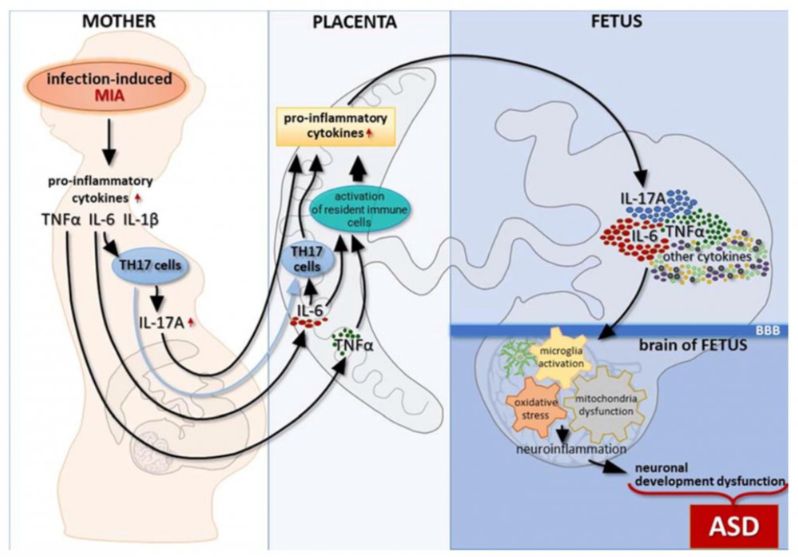
For much of modern medicine, autism spectrum disorder (ASD) was viewed primarily as a condition written into the genome, a neurodevelopmental difference emerging largely from inherited biology. But over the past two decades, scientists have begun uncovering another powerful influence operating alongside genetics: the immune system.
The Immune System’s Quiet Role in Brain Construction
Pregnancy requires extraordinary biological diplomacy. A fetus carries genetic material from both parents, meaning the mother’s immune system must tolerate tissue that is partly foreign while still remaining capable of defending against infection.
Normally, this balance is maintained through tightly regulated immune signaling. But infections, chronic stress, obesity, air pollution, and other inflammatory exposures can disturb that equilibrium.
When the immune system activates, it releases chemical messengers known as cytokines. These proteins help coordinate immune defenses, but they also influence fetal development. Scientists now suspect that excessive cytokine signaling during pregnancy may alter how neurons migrate, connect, and mature inside the fetal brain.
Among the most closely studied molecules are interleukin-6 (IL-6), interleukin-17A (IL-17A), and interleukin-1β (IL-1β). In animal studies, elevated levels of these inflammatory signals have been linked to changes in brain organization, altered social behavior, repetitive behaviors, and sensory abnormalities resembling features seen in autism.
What makes these findings especially compelling is that the immune system appears capable of influencing the brain long before birth.
Microglia: The Brain’s Hidden Architects
One of the major discoveries reshaping neuroscience involves microglia, the brain’s resident immune cells. For decades, microglia were thought to function mainly as janitors, cleaning up debris after injury or infection. Researchers now know they play a far more sophisticated role. During fetal and early childhood development, microglia help sculpt the brain itself. They guide synaptic pruning, remove unnecessary neural connections, and help fine-tune communication between neurons. In essence, they participate in wiring the brain.
Maternal immune activation appears capable of disrupting this process. Studies suggest that inflammatory cytokines can push microglia into an activated state prematurely, altering how they interact with developing neurons. Instead of delicately refining neural networks, activated microglia may begin producing inflammatory molecules and oxidative chemicals that interfere with normal maturation.
Some experiments have shown that prenatal exposure to diesel exhaust particles and other pollutants can delay microglial development and alter communication pathways between neurons and immune cells. These findings have intensified concerns about how modern environmental exposures may intersect with pregnancy and neurodevelopment.
Inflammation and the Oxidative Storm
The developing brain is extraordinarily energy hungry. Although it represents only a small fraction of body weight, it consumes enormous amounts of oxygen and metabolic fuel. That demand also makes it vulnerable.
One consequence of chronic inflammation is oxidative stress, the accumulation of highly reactive oxygen-containing molecules that damage proteins, lipids, and DNA. Under normal conditions, cells neutralize these molecules using antioxidant systems such as glutathione. But when inflammation becomes excessive, those defenses can be overwhelmed.
Researchers have repeatedly identified signs of oxidative imbalance in individuals with ASD, including increased markers of oxidative injury and reduced antioxidant capacity. The danger lies not only in the damage itself but in the feedback loop it creates. Inflammation generates oxidative stress, and oxidative stress further amplifies inflammation. Scientists increasingly view this cycle as a central engine driving neurodevelopmental disruption.
This emerging framework also helps explain why autism research is beginning to overlap with broader investigations into chronic inflammatory disease, metabolism, and environmental health.
The Mitochondria Connection
Deep inside nearly every cell are mitochondria, the microscopic structures responsible for producing energy. They are often described as the cell’s power plants, but mitochondria also function as sensors of stress and regulators of immunity.
In autism research, mitochondria have become impossible to ignore.
Multiple studies suggest that many children with ASD exhibit some degree of mitochondrial dysfunction or impaired cellular energy metabolism. When mitochondria falter, cells produce less ATP, the molecule that powers biological activity. At the same time, dysfunctional mitochondria can leak reactive oxygen species, fueling additional oxidative stress and inflammation.
The relationship may become self-reinforcing. Inflammatory signals damage mitochondria, while injured mitochondria release distress signals that stimulate further immune activation. Some researchers now refer to this phenomenon as “mitoflammation,” a merging of metabolism and inflammation into a single pathological process.
The concept is reshaping how scientists think about disorders once viewed strictly through the lens of brain circuitry.
Why Autism Appears More Common in Boys
Autism has long displayed a striking sex imbalance, with diagnoses occurring far more frequently in males than in females. Maternal immune activation models appear to mirror this pattern. In many experimental studies, male offspring exposed to prenatal inflammation show stronger behavioral abnormalities, more pronounced immune changes, and greater microglial disruption than females.
Researchers are still debating why. Hormonal influences may alter how the developing male brain responds to inflammatory stress. Female brains may possess protective mechanisms that buffer against some developmental insults. At the same time, scientists increasingly recognize that autism in girls may often be underrecognized because females can develop stronger compensatory social behaviors, masking symptoms during childhood. The question remains one of the field’s most intriguing mysteries.
The “Double Hit” Theory
Perhaps the most important insight emerging from maternal immune activation research is that autism may not arise from a single event, but from cumulative biological pressures unfolding across development.
Scientists sometimes describe this as the “double hit” hypothesis. Prenatal inflammation may prime the fetal immune and nervous systems, leaving them hypersensitive to later environmental challenges. Subsequent exposures, such as infections, chronic stress, pollutants, or inflammatory illnesses during childhood, could then amplify vulnerabilities already embedded during fetal life.
This model may help explain why autism is so heterogeneous. Different combinations of genes, immune exposures, metabolic states, and environmental factors could converge on similar developmental outcomes through entirely different biological routes. In that sense, autism may be less a single disorder than a spectrum of related neurodevelopmental pathways.
Could Inflammation Become a Therapeutic Target?
Understanding these immune pathways has sparked growing interest in therapies aimed at reducing inflammation or restoring metabolic balance.
In animal models, blocking inflammatory cytokines such as IL-6 or IL-17A has prevented some autism-like behaviors from emerging. Other experiments suggest potential benefits from probiotics, ketogenic diets, antioxidants, and flavonoid compounds that influence immune and mitochondrial function.
Human studies remain preliminary, but some small trials have explored anti-inflammatory medications and nutraceutical approaches with modest reported improvements in social behavior, irritability, or communication. Researchers caution that these findings are far from definitive, and no immune-based treatment currently represents an established therapy for ASD.
Still, the broader shift in thinking is significant. Scientists are beginning to view neurodevelopment not simply as a matter of genes and neurons, but as a dynamic conversation among the immune system, metabolism, environment, and the developing brain.
A New Biological Story of Autism
The emerging science of maternal immune activation is changing the intellectual landscape of autism research. The brain is no longer viewed as an isolated organ protected from the rest of the body. Instead, it appears deeply connected to immune signaling from the earliest stages of life. Cytokines, microglia, oxidative stress, and mitochondrial health may all participate in shaping the neural circuits that eventually govern social interaction, sensory processing, and cognition.
This does not mean autism can be reduced to inflammation alone. Genetics remain profoundly important, and most pregnancies involving infections or inflammatory exposures do not lead to autism. But the research increasingly suggests that the prenatal environment may influence how genetic risk unfolds.
In the process, scientists are uncovering something larger: the realization that the immune system may help write the developing brain’s first draft long before birth itself.
Reference
1. Patterson PH. Maternal infection and immune involvement in autism. Trends Mol Med. 2011;17(7):389-394. doi:10.1016/j.molmed.2011.03.001
2. Estes ML, McAllister AK. Maternal immune activation: Implications for neuropsychiatric disorders. Science. 2016;353(6301):772-777. doi:10.1126/science.aag3194
3. Bilbo SD, Block CL, Bolton JL, Hanamsagar R, Tran PK. Beyond infection - Maternal immune activation by environmental factors, microglial development, and relevance for autism spectrum disorders. Exp Neurol. 2018;299(Pt A):241-251. doi:10.1016/j.expneurol.2017.07.002
4. Usui N, Kobayashi H, Shimada S. Neuroinflammation and Oxidative Stress in the Pathogenesis of Autism Spectrum Disorder. Int J Mol Sci. 2023;24(6):5487. Published 2023 Mar 13. doi:10.3390/ijms24065487
5. Han VX, Patel S, Jones HF, et al. Maternal acute and chronic inflammation in pregnancy is associated with common neurodevelopmental disorders: a systematic review. Transl Psychiatry. 2021;11(1):71. Published 2021 Jan 21. doi:10.1038/s41398-021-01198-w