

Aerosol or Powder? Why the Type of Inhaler Can Change Where Asthma and COPD Medicine Goes
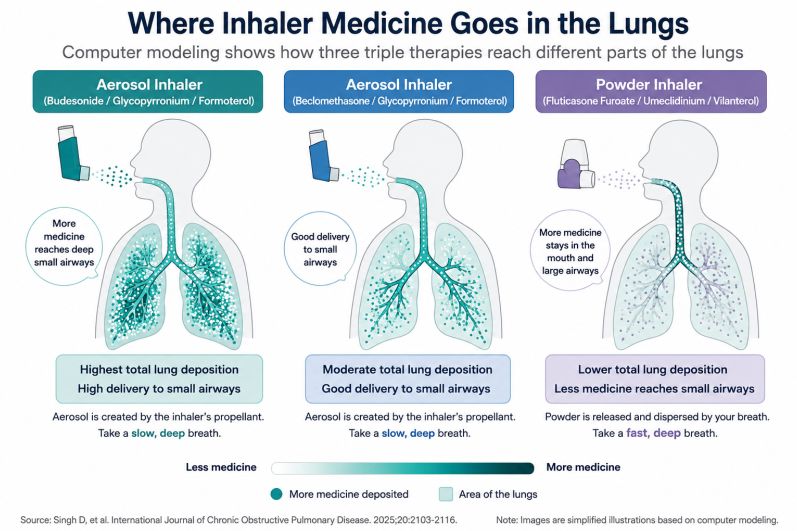
Some inhalers spray medicine into the airways, whereas others depend on the patient's breath to turn a powder into inhalable particles. That seemingly simple difference can influence how much medicine reaches the deepest parts of the lungs.
For most people, inhalers look broadly similar. Place the device in the mouth, breathe in and medication enters the lungs. But what happens inside the device can be dramatically different.
Some inhalers use a pressurized aerosol, essentially creating a fine mist of medication that is propelled from the device. Others contain dry powder and depend on the force of the patient's own breath to pull the medicine from the inhaler and break it into particles small enough to travel into the lungs.
This distinction between aerosol inhalers and powder inhalers is more than a matter of convenience. It changes the physics of how medication travels through the respiratory tract.
A 2025 study used three-dimensional models of the lungs of people with chronic obstructive pulmonary disease, or COPD, to compare three single-inhaler triple therapies.¹ The simulations found substantial differences in how much medication was predicted to enter the lungs and how much reached the small airways.
The findings do not establish that one inhaler is clinically superior to another. But they help illustrate something every inhaler user should understand: an inhaler is not simply a container for medicine. It is a drug-delivery machine.
First, What Is an Aerosol?
The word aerosol can be confusing because it is often associated with household spray cans. In medicine, it has a broader meaning.
An aerosol is simply a cloud of tiny liquid droplets or solid particles suspended in air or another gas. When particles are sufficiently small, they can be carried by inhaled air into the respiratory tract.
A pressurized metered-dose inhaler, commonly abbreviated pMDI, creates an aerosol using a propellant. When the canister is pressed, a precisely measured amount of medication is released under pressure. The propellant rapidly expands and produces a cloud of tiny medication-containing particles.
In other words, the inhaler supplies much of the energy needed to create the aerosol. The patient then breathes that aerosol into the lungs.
This is why patients using a conventional pMDI are generally instructed to inhale slowly and deeply. Breathing too quickly can cause particles to strike the mouth, throat and larger airways before they have a chance to travel farther into the lungs.
A Dry Powder Inhaler Works Almost in Reverse
A dry powder inhaler, or DPI, begins with medication in powdered form rather than a pressurized liquid formulation.There is no propellant spraying the medicine toward the lungs. Instead, the patient's inhalation provides the energy needed to operate the drug-delivery process.
When a person inhales through the device, air rushes through internal channels and encounters the powder. The airflow must lift the powder and, importantly, separate clumps of particles into much smaller particles capable of being inhaled.
This process is known as deagglomeration. Imagine trying to inhale flour. Individual microscopic particles may be tiny, but flour naturally forms clumps. If those clumps remain too large, they are unlikely to travel deeply into the lungs.
A dry powder inhaler is therefore engineered to use turbulence generated by the patient's breath to break apart these aggregates. For that reason, patients are usually instructed to inhale quickly and deeply through a DPI. That is almost the opposite of the technique generally recommended for a pressurized aerosol inhaler.
The Difference Comes Down to Who Supplies the Energy
The simplest way for consumers to understand the distinction is this:
With a pressurized aerosol inhaler, the device generates the aerosol. With a dry powder inhaler, the patient's breath helps generate the aerosol.
A pMDI uses propellant energy to release and disperse medication. The patient primarily needs to capture that aerosol with an appropriately timed inhalation.
A DPI depends much more heavily on inspiratory airflow to extract and disperse its powder.
Neither approach is inherently good or bad. Each has advantages and technique requirements. But this difference becomes particularly important in COPD because patients can vary considerably in how strongly they can inhale.
The Medicine Still Has a Long Way to Travel
Getting medication out of an inhaler is only the first step. Once particles enter the mouth, they must navigate an extraordinary branching structure.
Air travels past the tongue, turns through the throat and enters the trachea. The trachea divides into two main bronchi, which divide again and again into progressively smaller passages.
At the far reaches of this airway tree are the small airways, generally defined as airways less than two millimeters in diameter.
These tiny passages are particularly important in COPD. Inflammation, mucus, thickening and structural changes can narrow them. Some may close prematurely during exhalation, trapping air behind them and contributing to lung hyperinflation and shortness of breath.
Reaching these airways is therefore an important goal of inhaled therapy. But particles do not automatically follow inhaled air all the way there.
Why Some Medicine Never Makes It Past the Throat
Imagine driving quickly toward a sharp curve. A slow-moving car can follow the bend easily. A fast-moving vehicle has more momentum and is more likely to continue straight.
Aerosol particles behave in a similar way. Air can make sharp turns through the mouth, throat and branching bronchi. Particles with greater momentum may not follow those turns. Instead, they continue forward and collide with airway surfaces.
This process is called inertial impaction.
Particles that impact the mouth or throat are no longer available to reach the small airways. Particle size matters, but size is not the entire story. Density, shape and speed also influence how a particle behaves.
Researchers therefore often describe inhaled particles using their aerodynamic diameter, which reflects how the particle actually moves through air.
Smaller aerodynamic particles generally have less inertia and are better able to follow airflow around the respiratory system's many turns.
Why Faster Is Not Always Deeper
The difference between aerosol and powder inhalers creates an interesting paradox. A dry powder inhaler generally needs a relatively forceful inhalation because airflow helps break the powder into respirable particles.
But once those particles have been created, faster airflow can increase their velocity and inertia. That can increase the probability that particles collide with the throat or larger airways.
So a stronger inhalation can perform two competing jobs at the same time: it can improve powder dispersion, while also increasing the forces that can cause some particles to deposit earlier in the respiratory tract.
The final result depends on the inhaler's internal resistance, powder formulation, particle characteristics and the patient's inhalation.
Pressurized aerosol inhalers face a different challenge. Because the device generates the aerosol itself, a very forceful inhalation is not required to break apart a powder. Instead, a slower inhalation can help particles follow the airflow deeper into the bronchial tree.
Scientists Created Virtual COPD Lungs to Compare the Two Approaches
In the 2025 study, CT scans from 20 people with moderate to very severe COPD were transformed into detailed three-dimensional airway models.
A technique called functional respiratory imaging combined these anatomical models with computational fluid dynamics, the same broad field of physics used to model how air moves around airplanes, automobiles and buildings.
The characteristics of each inhaler were then incorporated into the simulations. Researchers compared three triple therapies containing an inhaled corticosteroid, a LAMA bronchodilator and a LABA bronchodilator.
Two were pressurized aerosol inhalers: budesonide/glycopyrronium/formoterol, or BGF, and beclomethasone dipropionate/glycopyrronium/formoterol, or BDP/G/F.
The third, fluticasone furoate/umeclidinium/vilanterol, or FF/UMEC/VI, was delivered as a dry powder.
The simulations estimated how much medication remained in the mouth and throat, how much reached larger airways and how much penetrated into the small-airway region.
The Pressurized Aerosol Delivered More of Its Dose Into the Modeled Lungs
At an inhalation flow of 30 liters per minute, approximately 55 to 58 percent of the delivered BGF dose was predicted to enter the lungs. Approximately 39 to 41 percent of BDP/G/F reached the lungs.
For FF/UMEC/VI, the dry powder therapy, predicted total lung deposition varied among its three drug components, at approximately 24 to 36 percent.
The location of deposition also differed. With BGF, roughly 31 to 33 percent of the delivered dose was predicted to reach the small-airway region. BDP/G/F also demonstrated strong peripheral targeting, in part because its formulation generates particularly small, or extrafine, aerosol particles.
In the simulations of FF/UMEC/VI, a larger proportion of the delivered dose was deposited in the mouth, throat and more central airways.
The comparison illustrates why the number printed on an inhaler does not tell the entire story. The labeled dose describes the medication delivered by the device under standardized conditions. It does not mean that every microgram reaches the lungs, much less the small airways.
What Happened When the Breath Became Faster?
The researchers also modeled BGF and FF/UMEC/VI at an inspiratory flow of 60 liters per minute. BGF's predicted total lung deposition remained relatively stable, at approximately 57 to 59 percent. Some deposition shifted toward larger airways, as would be expected when particles travel faster.¹The modeled total lung deposition of the dry powder therapy was approximately 28 percent overall at this flow.
For its inhaled corticosteroid component, predicted deposition in the small-airway region was approximately 7 percent of the delivered dose.
These results should not be interpreted to mean that patients using a DPI should simply inhale more slowly. A sufficiently forceful breath is required for many DPIs to disperse their powder correctly.
Instead, the findings demonstrate the engineering challenge faced by dry powder devices: airflow must be strong enough to disperse the powder while still producing particles capable of navigating the respiratory tract.
Not All Aerosol Inhalers Produce the Same Aerosol
Even the two pressurized inhalers in the study behaved differently. BGF uses a formulation known as Aerosphere cosuspension technology. Micronized drug crystals are associated with low-density porous phospholipid particles. This approach helps stabilize the formulation and allows the three medications to be aerosolized with similar characteristics.
The goal is codeposition, allowing the corticosteroid and two bronchodilators to reach similar regions of the respiratory tract. BDP/G/F uses a different strategy. Its medications are delivered in a solution. After the inhaler is actuated, droplets rapidly evaporate, leaving behind very small drug particles.
These extrafine particles have relatively little inertia and can travel efficiently toward peripheral airways. That helps explain why BDP/G/F produced a particularly low central-to-peripheral deposition ratio in the study, even though its total modeled lung deposition was lower than that of BGF.
Thus, simply labeling an inhaler as an “aerosol inhaler” does not fully describe its behavior. The formulation and resulting aerodynamic particle size also matter.
Particle Size Is Really About Particle Behavior
A common misconception is that the physically smallest-looking particle must travel deepest. Aerosol scientists instead focus on aerodynamic size.
A lightweight, porous particle can behave aerodynamically like a much smaller compact particle. Conversely, a dense particle can behave as though it were larger.
One commonly used measurement is the mass median aerodynamic diameter, or MMAD. Another is the fine-particle fraction, which describes how much of the aerosol consists of particles within a size range capable of reaching the lower respiratory tract.
These measurements help predict whether particles are likely to stop in the throat, settle in larger bronchi or continue toward peripheral airways. Inhaler design is therefore partly an exercise in particle engineering.
Aerosol Versus Powder Is Not the Same as Better Versus Worse
The deposition differences in the study are intriguing, but they require an important qualification. They do not prove that one inhaler produces better outcomes for every patient.
The investigation used computer simulations to examine aerosol deposition. It was not a randomized clinical trial comparing exacerbations, hospitalizations, symptoms or survival. The medications themselves also differ.
For example, BGF contains budesonide as its corticosteroid, whereas FF/UMEC/VI contains fluticasone furoate. These drugs have different molecular properties, potencies, receptor behavior, approved doses and pharmacokinetics.
It would therefore be misleading to conclude that an inhaler depositing twice as many micrograms of one corticosteroid necessarily provides twice the anti-inflammatory effect of another.
Deposition describes drug delivery. It does not by itself establish clinical superiority.
For Consumers, Technique Should Match the Device
The most practical lesson is that inhalers should not all be used the same way. With a conventional pressurized metered-dose aerosol inhaler, medication is propelled from the device. A slow, deep inhalation is generally used so that the aerosol can be carried into the lungs rather than striking the mouth and throat. Proper coordination between actuation and inhalation is important, and a spacer or valved holding chamber can simplify delivery for appropriate medications.
With a dry powder inhaler, there is no propellant creating the aerosol. The patient's inhalation provides the energy needed to withdraw and disperse the powder. A faster, deeper inhalation is therefore generally required, although the exact technique varies by device.
This difference explains why switching inhalers is not merely switching containers. A patient who uses the breathing technique learned for one device may not use another device effectively.
The Inhaler Is Part of the Treatment
Modern inhalers sit at the intersection of medicine and engineering. Inside a device that fits in the palm of a hand, pressure, airflow, turbulence, evaporation and particle physics are being manipulated to accomplish an extraordinarily difficult task: transporting microscopic quantities of medication through a twisting airway network and depositing them on specific regions of diseased lung.
The 2025 modeling study suggests that BGF delivered through a pressurized aerosol inhaler achieved high total lung deposition while maintaining substantial delivery to peripheral airways across the tested flow conditions. BDP/G/F showed particularly strong peripheral targeting with its extrafine aerosol, whereas FF/UMEC/VI, delivered as a dry powder, showed lower modeled peripheral deposition under the simulated conditions.
Whether these differences produce clinically meaningful advantages for particular patients remains an important question for clinical research. But for consumers, the underlying principle is much simpler.
An aerosol inhaler brings much of the energy needed to create the medication cloud. A powder inhaler asks your breath to help create it.
From there, physics determines which particles stop in the throat, which reach the larger breathing tubes and which continue into the smallest airways. For inhaled medicine, what is in the device matters. How that medicine becomes airborne, and where it lands, matters too.
Reference
1. Singh D, Roche N, Wu L, et al. In Silico Lung Deposition Profiles of Three Single-Inhaler Triple Therapies in Patients with COPD Using Functional Respiratory Imaging. Int J Chron Obstruct Pulmon Dis. 2025;20:2103-2116. Published 2025 Jun 27. doi:10.2147/COPD.S510214
2. Watz H, Barile S, Guastalla D, et al. Targeting the Small Airways with Inhaled Corticosteroid/Long-Acting Beta Agonist Dry Powder Inhalers: A Functional Respiratory Imaging Study. J Aerosol Med Pulm Drug Deliv. 2021;34(5):280-292. doi:10.1089/jamp.2020.1618
3. Usmani O, Li G, De Backer J, Sadafi H, Wu L, Marshall J. Modeled small airways lung deposition of two fixed-dose triple therapy combinations assessed with in silico functional respiratory imaging. Respir Res. 2023;24(1):226. Published 2023 Sep 23. doi:10.1186/s12931-023-02534-y
4. Usmani OS, Mignot B, Kendall I, et al. Predicting Lung Deposition of Extrafine Inhaled Corticosteroid-Containing Fixed Combinations in Patients with Chronic Obstructive Pulmonary Disease Using Functional Respiratory Imaging: An In Silico Study. J Aerosol Med Pulm Drug Deliv. 2021;34(3):204-211. doi:10.1089/jamp.2020.1601
5. Wachtel H, Emerson-Stadler R, Langguth P, Hohlfeld JM, Ohar J. Aerosol Plumes of Inhalers Used in COPD. Pulm Ther. 2024;10(1):109-122. doi:10.1007/s41030-023-00249-5